

Zellige or Faïence: Secrets to the Ultimate Wall Guide
- Moroccan Crafts Pottery & Zellige
 Maroc Fans
- 0
- 28 minutes read

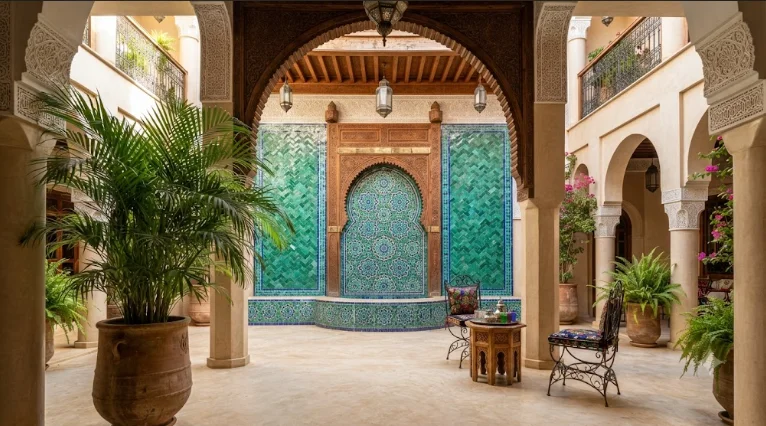
When designing a Mediterranean-inspired interior, few surface materials match the character of Moroccan ceramic tiles. However, interior designers often face a key question: Should you choose zellige or faïence tiles?
Although people sometimes confuse these terms, they represent two distinct ceramic traditions. These materials differ significantly in raw materials, manufacturing methods, edge profiles, and maintenance needs.
Choosing between handmade zellige tiles and modern glazed Moroccan faïence is vital for kitchen backsplashes or walk-in showers. This zellige or faïence guide examines both options to help you make an informed choice. Therefore, understanding zellige or faïence specifications ensures your design achieves both beauty and longevity.
1. Material Definitions: Fez Clay vs Earthenware in Zellige or Faïence
To evaluate zellige or faïence accurately, we must first look at their raw materials. While both share a rich regional heritage, their chemical makeups differ.
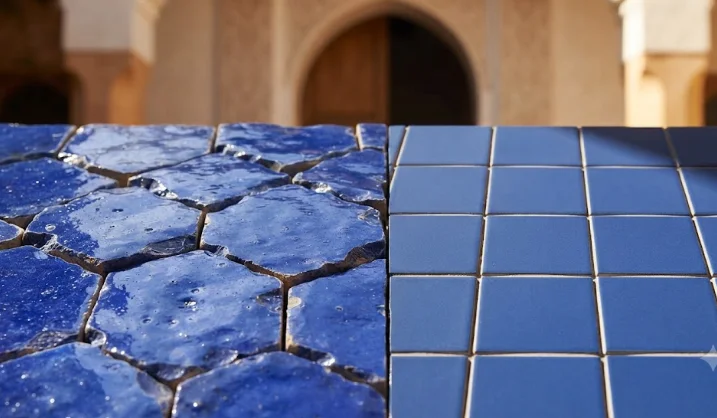
| Material Component | Authentic Zellige Tile | Moroccan Faïence Tile |
| Raw Material Source | Unrefined gray clay from Fez riverbeds | Purified ceramic clay and mineral blends |
| Initial Forming Method | Hand-molded into flat squares and sun-dried | Machine-pressed using high hydraulic pressure |
| Primary Firing Process | Wood-burning kilns fueled by olive pits | High-efficiency electric or gas roller kilns |
| Glazing Technique | Hand-enameled with liquid mineral oxides | Spray-glazed, screen-printed, or digital |
| Edge Finishing | Manually chiseled via a heavy iron manqar hammer | Precision square or factory-rectified straight edges |
| Visual Outcome | Irregular, organic surface with high shade shifts | Smooth, flat, standardized surface |
What is Authentic Moroccan Zellige?
Authentic zellige is a handcrafted tile technique from 10th-century North Africa. Native to Fez, it uses natural, unrefined gray clay from local riverbeds. Artisans soak the clay in water pits, hand-knead it, mold it into flat squares, sun-dry it, and fire it in wood-burning kilns.
After the first firing, workers apply liquid enamel glaze made with metallic mineral oxides before a second firing. A key feature of zellige or faïence discussions is its edge finishing: master artisans manually chisel each glazed square using a heavy iron hammer called a manqar. This manual chiseling creates a 45-degree reverse bevel on the back and raw, hand-cut edges on the front.
What is Moroccan Faïence?
Faïence refers to tin-glazed earthenware in classic ceramic terms. In modern Moroccan manufacturing, faïence describes glazed ceramic wall tiles made entirely in factories. Faïence uses refined, purified clays compressed with hydraulic presses into standard sizes.
Manufacturers fire these tiles in temperature-controlled roller kilns. This modern environment prevents heat shifts, resulting in flat surfaces and steady glazes. Consequently, Moroccan faïence captures traditional Mediterranean patterns while offering structural predictability.
2. Manufacturing and Craftsmanship Compared for Zellige or Faïence
The main difference between zellige or faïence options is human craftsmanship versus mechanical precision. Traditional production relies on generational mastery, whereas industrial manufacturing relies on automated consistency.
| Production Stage | Traditional Zellige Process | Modern Faïence Process |
| Step 1 | Natural Fez clay extraction from riverbeds | Purified clay and mineral blending |
| Step 2 | Outdoor pit soaking and hand-kneading | Hydraulic high-pressure mechanical pressing |
| Step 3 | Hand-molding into wooden frames | Automated spray glazing or digital patterns |
| Step 4 | Primary biscuit firing in wood kilns | Automated inkjet pattern application |
| Step 5 | Manual oxide glaze painting and pouring | Roller-kiln temperature-controlled firing |
| Step 6 | Secondary glaze-vitrification firing | Precision edge trimming and sorting |
| Step 7 | Manqar hand-chiseling at a 45-degree angle | Final batch sorting and packaging |
The Artisanal Zellige Workflow
- Clay Soaking: Raw clay softens in outdoor pits for several days to achieve plasticity.
- Hand Molding: Artisans press clay blocks into wooden frames and smooth them with wooden tools.
- Sun Curing: Raw tiles cure in the sun, where humidity creates natural size variations.
- Wood Kiln Firing: Temperature shifts inside traditional kilns cause slight changes in clay density.
- Hand Glazing: Workers paint or pour mineral oxide glazes over the face for deep color tones.
- The Manqar Cut: Artisans chisel each tile edge individually at a 45-degree angle. This allows zellige or faïence installations to feature almost no surface grout gap.
The Faïence Production Workflow
- Purified Clay Blending: Air bubbles and mineral pockets are removed to stop structural warping.
- High-Pressure Molding: Hydraulic machinery presses the clay paste into uniform square units.
- Uniform Spray Glazing: Glazes apply evenly, or geometric artwork screen-prints directly onto the tile body.
- Tunnel Kiln Firing: Temperature-controlled kilns maintain steady heat across every batch for high durability.
3. Visual and Aesthetic Differences in Zellige or Faïence
Aesthetics play a big role when choosing between zellige or faïence because both tile styles react to light differently.
       LIGHT REFLECTION COMPARISON

   Zellige Tile (Undulating Surface)
   ~~~~~~~~~~~~~~~~~~~~~~~~~~~~~~~~~
      Light Rays  │   │   │
                  ▼   ▼   ▼
               \   /  \  |  /
             ----'---'---'----  (Diffused, multi-directional shimmer)

   Faïence Tile (Flat Surface)
   ~~~~~~~~~~~~~~~~~~~~~~~~~~~
      Light Rays  │   │   │
                  ▼   ▼   ▼
               \   \   \   \
             -----------------  (Uniform, single-direction gloss/matte)
Light Play and Depth in Zellige or Faïence
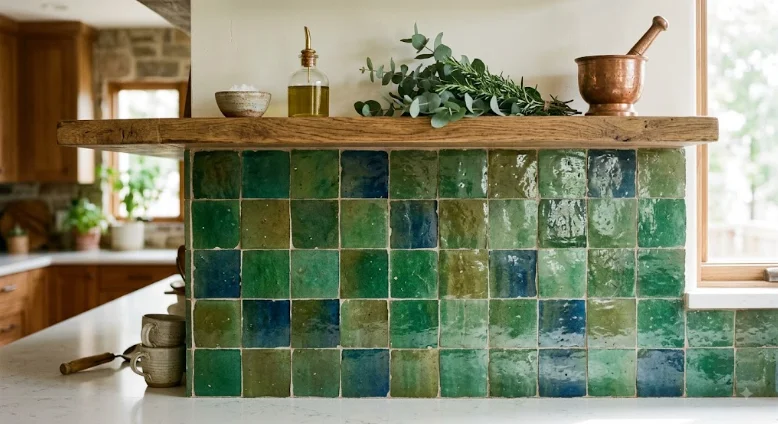
Zellige is famous for its intentional organic variation. Because surface irregularities mean no two tiles are alike, homeowners experience:
- Surface Relief: Micro-pitting and slight surface ripples catch light from multiple angles.
- Shade Movement: Tonal variation across a single colorway ranges from V3 to V4.
- Chiseled Borders: Micro-chipping along edges reveals the natural terracotta underneath.
Predictability and Geometry in Zellige or Faïence
Conversely, faïence offers a clean, structured look for modern interiors through:
- Flat Surfaces: Smooth, level tile faces provide a uniform finish without pits.
- Consistent Color Matching: Minimal shade variation across production runs.
- Sharp Geometric Definition: Smooth edges allow crisp alignment of printed Moorish artwork.
4. Technical Comparison Table for Zellige or Faïence
The matrix below compares the technical specifications and physical performance metrics of zellige or faïence.
| Specification Metric | Handcrafted Zellige Tile | Moroccan Faïence Tile |
| Primary Material | Unrefined Fez terracotta clay & mineral glazes | Purified ceramic or earthenware clay body |
| Manufacturing Method | 100% handcrafted and hand-chiseled (Manqar) | Machine-pressed or semi-industrial molded |
| Surface Finish | Undulating, micro-pitted, glossy or matte sheen | Flat, smooth, uniform glaze or digital print |
| Edge Finish | Hand-chiseled, 45° reverse bevel | Straight, square, or factory-rounded |
| Shade Variation Rating | High Variation (V3 to V4 shift) | Uniform Consistency (V1 to V2 shift) |
| Joint Width | Edge-to-edge / dry-stacked joint (< 1 mm) | Standard grout line (1.5 mm to 3 mm) |
| Water Absorption (Body) | Moderate (Porous terracotta back) | Low to Moderate (Standard ceramic body) |
| Tile Thickness | Variable (~10 mm to 12 mm) | Standardized (~7 mm to 9 mm) |
| Installer Requirement | Specialist mason experienced with zellige | Standard qualified tile contractor |
| Recommended Applications | Feature walls, backsplashes, fireplaces | Shower walls, high-moisture commercial areas |
5. Installation Protocols and Grouting Strategies in Zellige or Faïence
Installation is where structural differences in zellige or faïence show most. Standard tile setting methods work well for faïence, but zellige requires specialized masonry techniques.
                     GROUT & JOINT PROFILE CROSS-SECTION

      Authentic Zellige Installation             Standard Faïence Installation
      ------------------------------             -----------------------------
        Tile 1           Tile 2                    Tile 1             Tile 2
      ┌────────┐       ┌────────┐                ┌──────────┐       ┌──────────┐
      │ Glaze  │       │ Glaze  │                │  Glaze   │       │  Glaze   │
      │        │       │        │                │          │       │          │
      └───┐    │       │    ┌───┘                └──────────┘       └──────────┘
          \    │       │   /                         │    Grout Joint    │
           \   │ Grout │  /                          │  (1.5mm - 3.0mm)  │
            \  └───┬───┘ /                           └───┬───────────┬───┘
             \     │    /                                │           │
      ────────┴────┴───┴────────                 ────────┴───────────┴────────
      Flexible Mortar Bed                        Standard Thin-Set Bed
Specialized Installation for Hand-Chiseled Zellige or Faïence
Installing zellige requires a distinct approach due to thickness variations:
- Pre-Soaking: Because underlying terracotta clay is porous, workers soak zellige tiles in water before installation.
- Edge-to-Edge Dry Joint Setting: Installers set zellige edge-to-edge without plastic tile spacers.
- Flexible Thin-Set Application: Contractors apply flexible, polymer-modified thin-set mortar.
- Fluid Grouting: A fluid, non-sanded grout spreads across the entire surface with a rubber squeegee.
Standard Installation for Moroccan Faïence in Zellige or Faïence Projects
Installing faïence follows traditional tile-laying methods:
- Plastic tile spacers maintain straight grout lines.
- Standard thin-set mortars provide reliable adhesion on drywall.
- Sanded grouts apply using a standard rubber float.
6. Waterproofing, Durability, and Daily Maintenance for Zellige or Faïence
When choosing between zellige or faïence for wet areas like walk-in showers, moisture protection requires careful planning.
+---------------------------------------------------------------------------------------+
|                              WATERPROOFING REQUIREMENT                                |
+---------------------------------------------------------------------------------------+
|  Zellige in Wet Areas:                                                                |
|  [Tile Glaze (Impervious)] ──> [Hairline Grout Gaps] ──> [Porous Terracotta Backing]  |
|                                                                 │                     |
|                                                                 ▼                     |
|                                                     [WATERPROOF MEMBRANE]             |
|                                                     (Schluter / Liquid Guard)         |
|                                                                 │                     |
|                                                                 ▼                     |
|                                                        [Substrate Wall]               |
+---------------------------------------------------------------------------------------+
Waterproofing Wet Areas for Zellige or Faïence
The glazed surface of zellige is non-porous, but its underlying terracotta body absorbs moisture. Therefore, when installing zellige in wet environments:
- Contractors apply a sheet waterproof membrane directly to the substrate wall before laying mortar.
- Technicians apply a penetrating tile sealer after grouting to protect exposed chiseled edges.
Care and Maintenance Practices for Zellige or Faïence
- Cleaning Zellige: Homeowners use neutral soap mixed with warm water. Avoid harsh acid-based cleaners or bleach. Re-seal grout lines every 1 to 2 years.
- Cleaning Faïence: Faïence is compatible with most standard spray cleaners. The non-porous glazed surface wipes clean easily, requiring minimal upkeep.
7. Budget, Availability, and Eco-Friendliness in Zellige or Faïence
Budget limits and environmental factors help determine whether zellige or faïence is right for a project.
   AVERAGE MATERIAL & LABOR COST COMPARISON ($ USD / SQ FT)

   Zellige Tile
   ==================================================== $20 - $60+ (Materials)
   ================================= $15 - $35 (Specialized Labor)
   Total: $35 - $95+ / sq ft

   Moroccan Faïence
   ============== $6 - $18 (Materials)
   ========== $5 - $12 (Standard Labor)
   Total: $11 - $30 / sq ft
Material and Labor Costs for Zellige or Faïence
- Zellige Investment: Authentic zellige ranges from $20 to $60+ per square foot for material alone, reflecting manual labor and international freight. Specialized installer labor adds $15 to $35 per square foot.
- Faïence Cost: Moroccan faïence generally ranges from $6 to $18 per square foot, with standard installation labor costing $5 to $12 per square foot.
Sustainability Profile for Zellige or Faïence
Authentic zellige is a natural ceramic material made from raw clay and organic mineral oxides. It fires using olive pit agricultural waste in traditional kilns, making it an eco-friendly artisan choice.
8. Decision Matrix: Selecting Zellige or Faïence for Your Project
To determine which tile suits your project, review the target application criteria below:
                     WHICH TILE SHOULD YOU SPECIFY?

                      /                          \
                     /                            \
                    ▼                              ▼
      SELECT AUTHENTIC ZELLIGE           SELECT MOROCCAN FAÏENCE
      ------------------------           -----------------------
      • Kitchen Backsplashes             • Full Shower Surrounds
      • Fireplace Surrounds              • Commercial Wall Spaces
      • Powder Room Accent Walls         • High-Traffic Family Baths
      • Custom Niche Highlights          • Budget-Conscious Walls
      • Luxury Commercial Features       • Precision Pattern Grids
Choose Handcrafted Zellige or Faïence Options If:
- You value tactile texture, hand-chiseled charm, and light reflections.
- You create a feature element, such as a kitchen backsplash or fireplace.
- You feel comfortable with organic variation and minor surface flaws.
Choose Moroccan Faïence in Zellige or Faïence Layouts If:
- You prefer crisp geometric art, aligned patterns, and straight grout lines.
- You tile large wall areas where material and installation cost efficiency is required.
- You want a low-maintenance wall finish for busy family bathrooms.
9. Frequently Asked Questions
Q1: Can zellige tiles be used on floors?
Glazed zellige serves primarily as wall applications because high-gloss glazes become slippery when wet. Instead, choose unglazed terracotta tiles (Bejmat) or floor-rated faïence ceramic tiles for flooring.
Q2: Why do zellige tiles have tiny chips along the edges?
Chipped edges are an expected result of the hand-chiseling process with the manqar hammer. These minor cuts expose the raw clay beneath the glaze, creating the distinct border texture of authentic zellige.
Q3: How do I tell authentic zellige apart from machine-made imitations?
Authentic zellige features a raw terracotta backing, variable tile thickness, hand-chiseled 45-degree beveled edges, and natural shade variations. Factory imitations feature uniform backings and straight edges.
Q4: Does zellige require sealing after installation?
Glazed zellige faces do not absorb sealer, but applying a penetrating sealer over the installation after grouting protects exposed terracotta edges.
Q5: Can I combine zellige and faïence in the same space?
Yes. A common approach involves using easy-to-clean faïence on primary shower walls while specifying handcrafted zellige on an accent wall to create a focal point.
10. Conclusion
Choosing between zellige or faïence comes down to balancing authentic craftsmanship against structural predictability, project budgets, and maintenance expectations. While Moroccan faïence provides clean patterns and efficient installation, authentic zellige brings an organic, light-reflecting beauty that machine production cannot recreate.