


Moroccan Handicrafts: The ultimate Guide to Traditional Crafts
- Home Décor & Traditional Crafts Moroccan Crafts
 Maroc Fans
- 1
- 25 minutes read

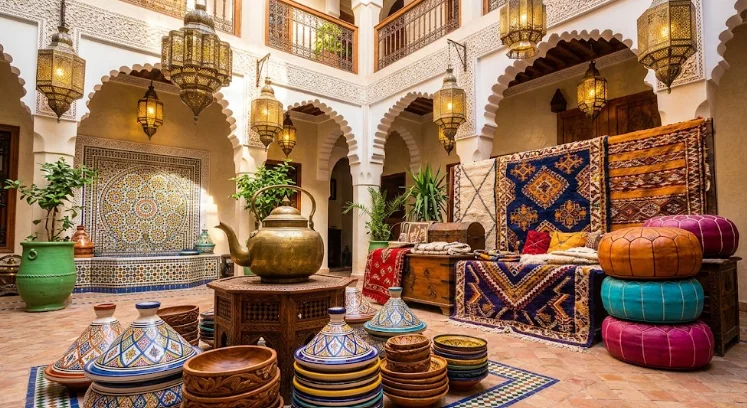
Morocco’s rich cultural tapestry is woven from centuries of Amazigh (Berber), Arab, Andalusian, and African influences. However, nowhere is this vibrant heritage more tangible than in the world of moroccan handicrafts. From the bustling souks of Marrakech and Fez to quiet artisan workshops in coastal Essaouira and the Rif Mountains, traditional craftsmanship (l’artisanat marocain) remains the beating heart of the nation’s identity and economy.
Master artisans, known locally as maalems, pass down complex techniques from generation to generation. Using raw, locally sourced materials—clay, wool, leather, metal, and wood—these craftspeople create items that are both everyday household necessities and exquisite works of art. Therefore, whether you are a traveler planning your first trip, an interior design enthusiast, or a collector of global art, this comprehensive guide explores the history, techniques, regional specialties, and sustainability of moroccan handicrafts.
The History and Cultural Significance of Moroccan Crafts
The story of traditional craft traditions spans thousands of years. Indigenous Amazigh tribes first laid the foundation with functional, geometric pottery, hand-spun wool weaving, and rugged silver jewelry designed for nomadic mountain life. Furthermore, with the arrival of Islam in the 7th century and the subsequent influx of Andalusian refugees fleeing the Spanish Reconquista in the 15th century, craft techniques underwent a sophisticated evolution.
Andalusian artisans brought refined urban traditions, introducing intricate floral motifs, complex wood carving, zellije tilework, and advanced leather tanning techniques. As a result, over centuries, these varied influences merged into a singular artistic movement protected by strict guild systems overseen by the maalem masters.
Today, traditional crafts account for a significant portion of Morocco’s national economy, employing roughly 20% of the active population. In addition, beyond commerce, these handmade goods serve as living expressions of spiritual devotion, tribal lineage, and historical preservation.
1. Moroccan Handicrafts in Ceramics and Pottery (Fakhkhar)
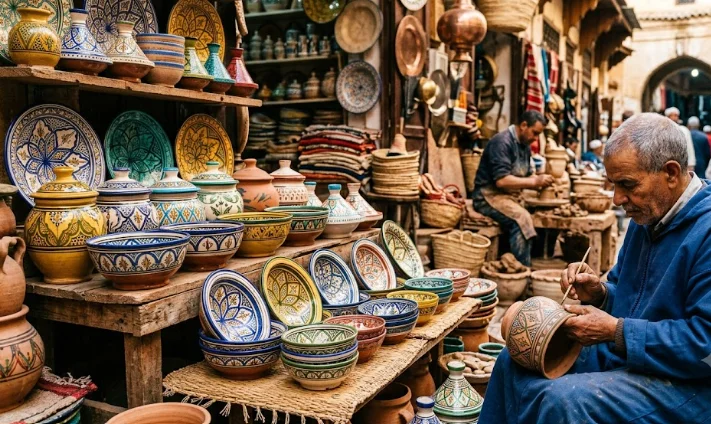
Ceramics are among the most iconic moroccan handicrafts, recognizable worldwide for their striking patterns and rich colors. Because techniques vary by location, traditional pottery falls broadly into two distinct categories: rural Amazigh pottery and urban glazed ceramics.
Rural Amazigh Pottery
Crafted primarily by women in mountain regions like the Rif and the High Atlas, rural pottery is unglazed, minimalist, and deeply functional. Artisans use hand-built coil techniques rather than potter’s wheels. Meanwhile, the earthenware vessels are painted with natural mineral pigments—often black charcoal and red ochre—creating bold geometric lines that reflect ancient tribal symbols.
Urban Glazed Ceramics (Fez & Safi)
Urban pottery represents the pinnacle of decorative technique:
- Fez Pottery: Renowned for its signature cobalt blue glaze (Bleu de Fès) derived from local minerals. Artisans paint intricate Islamic geometric and arabesque patterns onto a white tin-glazed base before double-firing the pieces in traditional wood-burning kilns.
- Safi Ceramics: Known as the ceramic capital of Morocco, Safi produces colorful pottery utilizing bright yellows, emerald greens, and deep greens, alongside modern interpretations of classical designs.
For an insider look at how these pieces fit into regional travel itineraries, explore our detailed Guide to Exploring the Souks of Fez.
2. Hand-Woven Textiles and Moroccan Handicrafts Rugs (Zarabi)
No discussion of moroccan handicrafts is complete without highlighting hand-woven carpets. In fact, these rugs are prized globally by interior designers for their warmth, texture, and abstract art aesthetics.
+———————————————————————–+
| CLASSIFICATION OF RUGS |
| |
| +————————–+ +——————————+ |
| | Tribal / Rural | | Urban Rugs | |
| | (Beni Ourain, Azilal) | | (Rabat, Medallion) | |
| +————+————-+ +————–+—————+ |
| | | |
| v v |
| – Thick, plush wool pile – Short, fine silk/wool pile |
| – Organic, asymmetrical motifs – Symmetrical, floral medallions |
| – Natural ivory & black/brown – Rich crimson, blue, gold dyes |
+———————————————————————–+
Beni Ourain Rugs
Originating from the cold North-Eastern Middle Atlas Mountains, Beni Ourain rugs are crafted from 100% undyed natural wool. Specifically, they feature a thick, plush pile with minimal dark brown or black geometric lines forming diamonds against a creamy white background.
Azilal and Boujaad Rugs
Hailing from the High Atlas region, Azilal rugs feature shorter pile wool and vibrant, painterly storytelling. Women weavers use vegetable-dyed wool in fluorescent pinks, turquoise, saffron yellow, and deep indigo to tell stories of fertility, nature, and personal milestones. Similarly, Boujaad rugs lean toward warm tones of terracotta, magenta, and rose.
Kilims (Hanbel)
Flat-woven rugs, or hanbels, are lightweight textiles ideal for warmer climates. Moreover, they feature tight, flat stitches and intricate tapestry weaves, often utilized as wall hangings, blankets, or floor coverings.
Learn more about selecting authentic textiles by visiting our guide on How to Choose an Authentic Moroccan Rug.
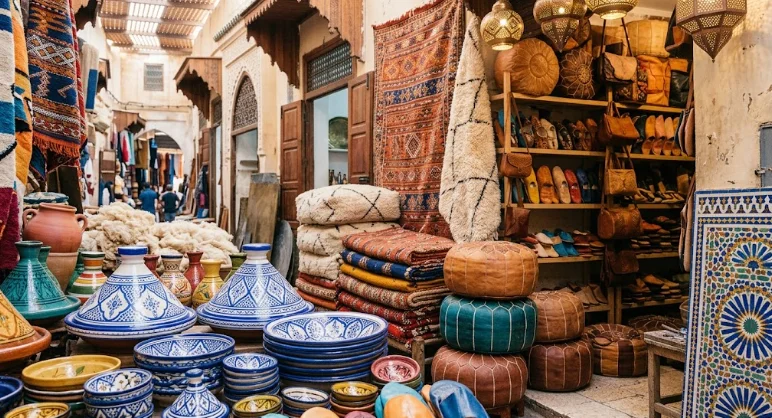
3. Traditional Moroccan Handicrafts in Leatherwork (L’Artisanat du Cuir)
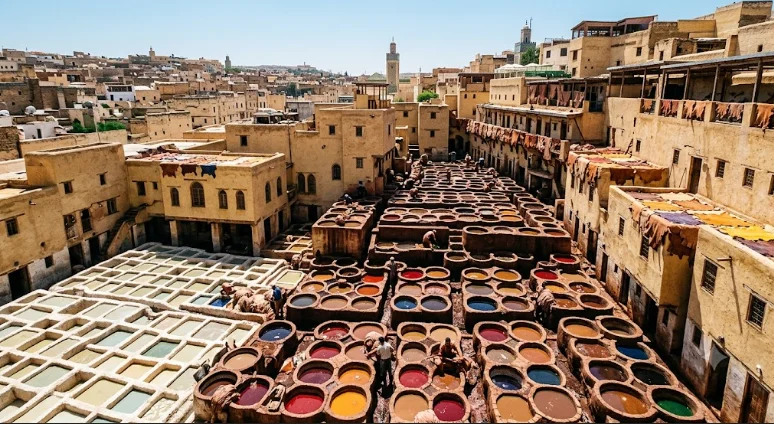
The art of leatherworking in Morocco is inextricably tied to the medieval tanneries of Fez and Marrakech, where methods have remained virtually unchanged since the 11th century. For example, at the famous Chouara Tannery in Fez, raw hides are soaked in natural limestone and pigeon guano mixtures to soften the leather. Afterward, they are hand-dyed in stone vats filled with organic materials:
- Poppy flowers for red
- Saffron/Pomegranate for yellow
- Indigo for blue
- Cedarwood for brown
Iconic Moroccan Leather Goods
- Babouches (Belgha): Traditional slipper-like shoes with flat heels, pointed or rounded toes, worn by both men and women.
- Leather Poufs: Stitched and embroidered floor cushions, often decorated with intricate spiral or star patterns.
- Bags & Accessories: Travel bags, saddles, and journals crafted from durable, hand-treated goat or camel leather.
4. Architectural Moroccan Handicrafts: Zellige Tilework and Plaster
Zellige is the world-famous Moroccan mosaic art made from hand-chiselled terracotta tile fragments assembled into elaborate geometric patterns. Consequently, it stands as one of the most complex architectural moroccan handicrafts.
The Zellige Process
- Clay Preparation: Natural clay from Fez is mixed with water, kneaded, and shaped into flat square tiles (bejmat).
- Glazing & Firing: Tiles are glazed in solid colors and kiln-fired.
- Chiseling (Nqach): Master artisans use a heavy, sharp hammer (manqash) to manually cut each square tile into precise geometric shapes.
- Assembly: Finally, the pieces are placed face-down on the ground in a reverse puzzle assembly before being sealed with mortar.
Zellige adorns fountains, mosques, palaces, and traditional riads across Morocco. Thus, alongside carved cedarwood (zouak) and sculpted plaster (stucco), zellige forms the triad of classic Moroccan Islamic architecture.
Planning a home renovation inspired by traditional craftsmanship? Read our collection of Moroccan Riad Interior Design Ideas.
5. Metalwork: Lanterns, Teapots, and Brasswork
Moroccan metalworkers (Saffarine) transform raw sheet metal, copper, brass, and nickel silver into functional lighting and tea service items. Indeed, metal products are an essential pillar of moroccan handicrafts.
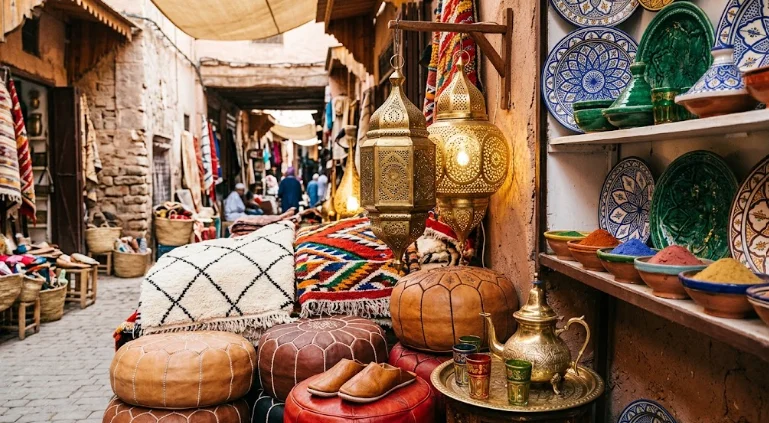
- Moroccan Lanterns: Pierced by hand using small chisels, these brass and copper lamps cast intricate geometric light patterns across walls. Additionally, some incorporate colored stained glass panels for warmth.
- Traditional Teapots (Berrad): Essential to Moroccan hospitality, tea service sets are crafted from brass or nickel silver, heavily engraved with Arabesque scrolls, and designed to withstand direct flames.
- Wrought Iron: Used extensively for decorative window grilles, courtyard furniture, and ornate mirrors.
Regional Specialties of Moroccan Handicrafts
Different cities in Morocco specialize in unique artistic disciplines based on historical guilds, local resources, and cultural influence.
| City / Region | Primary Craft Specialty | Materials Used | Key Characteristics |
| Fez | Blue Ceramics, Tanning, Zellige | Local clay, hides, mineral glazes | Intricate cobalt geometric motifs, medieval methods |
| Marrakech | Leather goods, Brass, Carpets | Leather, brass, sheep wool | Bold urban designs, diverse market styles |
| Safi | Glazed Pottery & Stoneware | Coastal clay, polychrome glazes | Bright glaze, modern daily ceramic wear |
| Essaouira | Marquetry & Woodworking | Thuya wood, lemon wood | Aromatic cedar/thuya wood inlay, smooth finish |
| Tiznit | Amazigh Silver Jewelry | Sterling silver, coral, enamel | Heavy tribal cuffs, fibula pins, cloisonné enamel |
| Middle Atlas | Beni Ourain & Azilal Rugs | Virgin sheep wool, natural dyes | Thick plush pile, minimalist dark lines, abstract art |
6. Sustainable Moroccan Handicrafts: Woodworking and Thuya Inlay
In the coastal city of Essaouira, the air smells of sea salt and aromatic wood. Here, artisans specialize in marquetry using wood from the rare Thuya tree (Tetraclinis articulata), native to the Western Atlas Mountains.
Artisans hollow out the knotty burl of the thuya wood—celebrated for its rich mahogany hues—and inlay it with contrasting materials like lemon wood, mother-of-pearl, ebony, and silver wire. As a result, common items include fine jewelry boxes, chessboards, and handcrafted furniture, making them highly prized moroccan handicrafts.
To explore coastal craft workshops, check out our Traveler’s Guide to Essaouira.
7. Traditional Amazigh Silver Jewelry
Unlike urban centers that historically preferred gold, Amazigh communities in southern Morocco (such as Tiznit and Taroudant) have a rich tradition of crafting heavy silver jewelry. Therefore, these ornaments remain vital moroccan handicrafts representing indigenous culture.
Key Pieces & Symbols
- The Fibula (Tazra): Triangular silver brooches connected by chains, used to fasten traditional cloaks. The triangle represents protection and womanhood.
- Cloisonné Enamel & Cabochons: Pieces adorned with yellow, green, and blue enamel, accented with raw coral and amber beads.
- The Khamsa (Hand of Fatima): A widespread motif used as a talisman to ward off the evil eye.
Ethical Shopping for Moroccan Handicrafts
As demand for moroccan handicrafts grows worldwide, sustainable sourcing and fair trade practices have become crucial. Because mass production threatens traditional methods, buying directly from artisan cooperatives ensures fair wages, preserves endangered techniques, and supports local community development.
+—————————————————————–+
| ETHICAL BUYING PRACTICES IN MOROCCO |
| |
| [ Buy Direct ] —-> Visit female-led weaving cooperatives |
| [ Inspect ] —-> Look for minor imperfections (handmade) |
| [ Verify ] —-> Ask about materials (wool vs synthetic) |
| [ Value Craft ] —-> Bargain respectfully with master artisans|
+—————————————————————–+
When shopping in the souks:
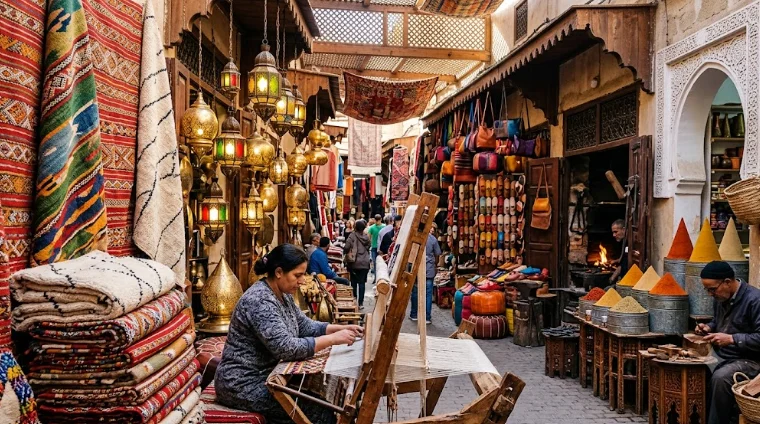
- Differentiate Handmade from Factory-Made: True handmade rugs have slight variations in knot symmetry; authentic zellige has minor surface imperfections; genuine leather carries a natural earthy smell rather than harsh chemical odors.
- Support Artisans Directly: Seek out government-certified artisan complexes (Ensemble Artisanal) or female-run weaving cooperatives in rural mountain towns.
- Bargain Respectfully: Negotiating prices in Morocco is a social custom. However, always approach bargaining with lighthearted humor and respect for the craftsman’s time and labor.
Learn more about responsible tourism practices through our Guide to Sustainable Travel in Morocco.
External Resources & Official Institutions
For academic research, historical preservation standards, and official artisan certifications, consult these reputable international organizations and government portals:
- UNESCO Intangible Cultural Heritage: Documentation on Moroccan craft traditions and heritage conservation.
- Maison de l’Artisan: Official regulatory body promoting Moroccan craftsmanship globally.
- Victoria and Albert Museum: Extensive archives on historical North African ceramics, metalwork, and textiles.
Frequently Asked Questions (FAQ)
What makes Moroccan handicrafts unique?
Moroccan handicrafts are distinguished by their blend of Amazigh, Arab, Andalusian, and African cultural influences. Furthermore, the reliance on centuries-old manual techniques, natural raw materials, and symbolic geometric patterns gives each piece a distinct, artisanal identity that mass production cannot replicate.
How can I tell if a Moroccan rug is authentic?
An authentic handmade wool rug will feature unique asymmetrical designs, hand-tied knots visible on the underside, and natural color variations. For instance, if you burn a loose thread from an authentic wool rug, it will extinguish quickly and smell like burnt hair; synthetic fibers will melt and smell like plastic.
Why is Fez famous for ceramics and leather?
Fez has been Morocco’s spiritual and artistic capital for over a millennium. Because the city benefits from rich local clay deposits perfect for tin-glazed pottery and historical access to abundant water supplies, its traditional industries have flourished for centuries.
Is it safe to ship large handicrafts home?
Yes, however, you should always choose established vendors. Most reputable shops in major cities routinely arrange international shipping via DHL, FedEx, or maritime freight. In addition, always secure a signed receipt, tracking number, and detailed insurance policy before departing the shop.
1 Comment
[…] 26, 2026 Home Décor & Traditional […]