

Moroccan Rug Comparison: Secrets to the Perfect Choice
- Carpets & Weaving Moroccan Crafts
 Maroc Fans
- 0
- 15 minutes read

Moroccan rug comparison guide helps you explore handwoven textiles that have captivated interior designers and homeowners worldwide for decades. In any detailed review, these creations stand out not merely as floor coverings, but as living pieces of Amazigh history. Furthermore, prized for their tactile warmth, artistic heritage, and unmatched quality, they bring timeless character to modern homes.
When decorating a space with authentic Moroccan crafts, two distinct styles consistently dominate the conversation: Azilal rugs and Beni Ourain rugs. Although both originate from the rugged Atlas Mountains, their visual aesthetics, textures, and cultural expressions could not be more different.
Are you torn between the minimalist elegance of a plush neutral rug and the vibrant storytelling of a colorful woven masterpiece? Consequently, this ultimate Moroccan rug comparison breaks down everything you need to know—from raw materials and pile height to interior styling and practical care—so you can confidently choose the perfect rug for your home.
1. Origins and History in This Moroccan Rug Comparison
To truly appreciate these artistic creations, however, it helps to understand the geography and ancestral heritage behind their loom setups. Indigenous Amazigh women traditionally crafted both rug styles, not for commercial trade, but as practical household items designed to withstand harsh mountain climates.
The Mountain Origins of Beni Ourain Rugs
Beni Ourain rugs originate from the cold northeastern Middle Atlas Mountains of Morocco. Crafted by a confederation of 17 distinct Amazigh tribes, these heavy textiles were engineered specifically for supreme warmth and survival. High up in the snow-capped peaks, families used dense wool blankets as bedding, floor insulation, and protective cloaks during severe winters. Therefore, the minimalist, monochromatic aesthetic naturally reflected the undyed tones of local sheep and the stark, serene mountain landscapes.
The Regional Origins of Azilal Rugs
Meanwhile, Azilal rugs come from the remote, high-altitude Azilal province in the Central High Atlas region. Isolated by steep valleys and dramatic terrain, weavers in this area developed an exceptionally creative and individualistic textile art form. Unlike the heavy bedding rugs of the Middle Atlas, however, Azilal rugs served as lighter floor coverings, sleeping mats, and decorative wall hangings. Because local flora, minerals, and bright yarns provided rich dyes, Azilal weavers transformed their looms into vibrant canvases of personal expression, abstract storytelling, and tribal symbolism.
2. Materials, Pile Height, and Texture Comparison
The physical feel underfoot and structural weight of a rug heavily dictate where it belongs in your home. Moreover, the key difference in wool processing and knotting techniques between these two styles creates two entirely distinct tactile experiences.
Beni Ourain Texture in Our Moroccan Rug Comparison
Beni Ourain rugs are renowned for their luxurious softness. Specifically, artisans weave them using pure virgin wool sourced from High Atlas sheep. Because this raw fiber is naturally rich in lanolin, the rug stays extremely soft and stain-resistant over time. In addition, artisans utilize a double-knot technique with long pile fibers, resulting in a plush thickness that reaches up to two inches. Walking on an authentic Beni Ourain feels like stepping onto a cloud, and it provides exceptional thermal insulation for colder rooms.
Azilal Texture in Our Moroccan Rug Comparison
While Azilal rugs also utilize a base of natural wool, their knotting structure differs significantly. As a result of alternating single lines of knotted pile with flat-woven Kilim rows, weavers create a much lower, tighter pile height under one inch. Furthermore, older or highly artistic Azilal pieces occasionally incorporate dyed cotton or recycled fabric threads to achieve intensely saturated colors. Consequently, an Azilal rug feels firm and stable underfoot, resembling a detailed textile tapestry rather than a deep mattress cushion.
3. Aesthetics and Design in This Moroccan Rug Comparison
Aesthetics are usually the decisive factor when reviewing any Moroccan rug comparison. Indeed, each style reflects a different philosophy of Amazigh weaving art.
Beni Ourain Minimalist Aesthetics
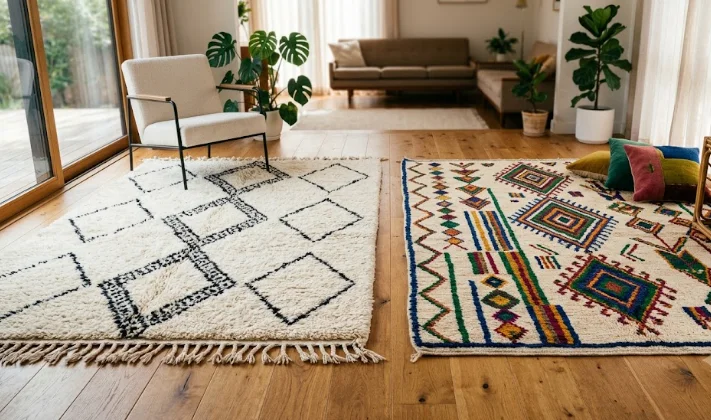
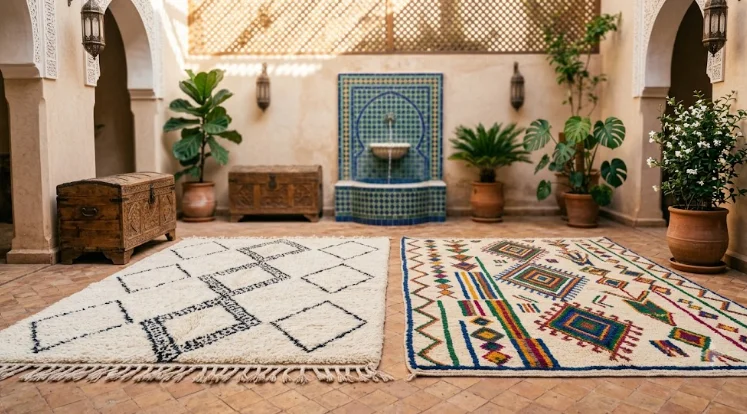
The hallmark of a traditional Beni Ourain rug is its restrained color palette. While the background displays natural cream or warm ivory, artisans weave geometric patterns using dark sheep wool in shades of charcoal and deep brown. For example, classic diamond patterns symbolize protection against the evil eye, whereas lattice lines represent mountain paths and life journeys. In addition, minor variations in line thickness prove the handmade authenticity of each piece. This understated look makes the Beni Ourain an exceptionally versatile foundation for modern, industrial, or Scandinavian spaces.
Azilal Expressive Aesthetics
If a Beni Ourain rug is a classic black-and-white photograph, however, an Azilal rug is an abstract oil painting. Set against a clean natural ivory backdrop, these vibrant creations explode with electric blues, saffron yellows, magentas, and emerald greens. Each unique motif represents personal milestones, ancestral protector symbols, or nature woven spontaneously without a pre-drawn template. For instance, the composition can feature floating geometric shapes or sudden color shifts across the weave, making every piece a one-of-a-kind art installation.
4. Room-by-Room Moroccan Rug Comparison and Styling Guide
Integrating a Moroccan rug into your interior design depends on your room’s traffic levels, existing color palette, and desired atmosphere.
Where to Style a Beni Ourain Rug
Due to its deep pile and comforting warmth, a Beni Ourain rug excels in spaces dedicated to relaxation. For instance, placing a Beni Ourain under a bed creates a soft landing for your feet every morning. Similarly, pairing a neutral Beni Ourain with sleek leather couches or modern minimalist seating elevates formal living rooms without visual clutter. Furthermore, the natural wool density makes it an extra-soft floor cushion for nurseries and quiet reading nooks.
Where to Style an Azilal Rug
Thanks to its tighter knotting and lower pile height, an Azilal rug thrives in high-traffic zones that need visual excitement. For example, lower pile height allows dining chairs or desk chairs to slide smoothly across the surface without catching long fibers. In addition, intricate colorful patterns are far more forgiving at disguising foot-traffic wear in entryways and busy hallways. Consequently, these artistic pieces also look stunning when hung on walls as textile fine art.
5. Durability and Care in This Moroccan Rug Comparison
Both styles are handwoven from durable wool, but their differing pile heights mean maintenance routines vary slightly in this Moroccan rug comparison.
Maintenance for Beni Ourain Rugs
Routine care requires avoiding high-powered vacuums with rotating beater bars, as they can pull long wool fibers. Instead, use a suction-only nozzle for regular cleaning. Although new high-pile wool rugs naturally shed loose fibers during the first few months, gentle vacuuming will resolve this over time. For liquid spills, blot immediately with a clean dry towel rather than scrubbing the wool.
Maintenance for Azilal Rugs
The lower pile of an Azilal rug makes routine vacuuming significantly easier and quicker than deep-pile carpets. Furthermore, Azilal rugs experience minimal shedding because of their tightly knotted construction. For minor spot cleaning, standard wool-safe carpet cleaners or diluted mild detergent work effectively.
6. How to Spot Authentic vs. Synthetic Rugs
With the global popularity of Moroccan interior trends, synthetic machine-made knockoffs have flooded the market. Therefore, here is how to ensure you are buying an authentic Moroccan rug handcrafted in the Atlas Mountains:
First, check the fringe of the rug. Authentic Moroccan rugs have fringes attached directly to the warp threads of the loom structure, whereas synthetic copies have fringes sewn on separately.
Second, examine the backing by flipping the rug over. Hand-knotted rugs exhibit irregular, individual knots on the reverse side, while machine-made rugs show perfectly uniform grid stitching.
Third, inspect the fiber using a simple burn test on a tiny loose strand. Genuine handwoven wool smells organic and burns to ash, whereas synthetic polyester melts into hard plastic beads.
Finally, feel the weight and thickness of the piece. Authentic wool rugs possess substantial natural weight that keeps them flat on the floor without curling at the corners.
Final Verdict: Which Style Wins This Moroccan Rug Comparison?
After reviewing this Moroccan rug comparison, there is no wrong choice—only the choice that best fits your lifestyle, decor vision, and tactile preference.
Choose a Beni Ourain rug if you love cloud-like softness underfoot and prefer minimalist, Scandinavian, or modern organic aesthetics. On the other hand, choose an Azilal rug if you want a striking pop of color, appreciate abstract narrative art, and need a lower-pile carpet for high-traffic areas.
Ultimately, whichever style you invite into your home, you are investing in a piece of living Amazigh history crafted by skilled female artisans whose traditions have endured for generations.
Frequently Asked Questions (FAQ)
1. Are Azilal rugs made of 100% natural wool?
Yes, authentic Azilal rugs feature a foundation of 100% natural, un-dyed white sheep wool. Furthermore, the colorful accent patterns are traditionally created using dyed wool or recycled textile threads to achieve vibrant hues.
2. Why are Beni Ourain rugs so expensive?
Beni Ourain rugs are investment pieces due to their high wool density and labor-intensive crafting process. Specifically, it takes months for skilled artisans to wash, card, spin, hand-dye, and double-knot a single large carpet on traditional vertical looms.
3. Which rug is better for homes with pets or children?
Azilal rugs are generally more practical for busy households with children or pets. For instance, their lower pile height traps less dust and hair, making spot cleaning much simpler compared to deep-pile rugs.
4. Do Beni Ourain rugs shed wool fibers?
Yes, authentic newly woven Beni Ourain rugs naturally shed light wool fibers for the first few weeks. However, regular gentle vacuuming without a rotating brush will naturally reduce shedding over time.
5. Can I use a Beni Ourain or Azilal rug over wall-to-wall carpet?
Both rug styles can easily be layered over existing carpeted floors. Therefore, using a quality non-slip rug pad underneath helps keep the rug anchored securely and protects the weave structure over time.