
Moroccan Carpet Patterns: Secrets to the Ultimate Buy
- Carpets & Weaving Moroccan Crafts
 Maroc Fans
- 0
- 21 minutes read
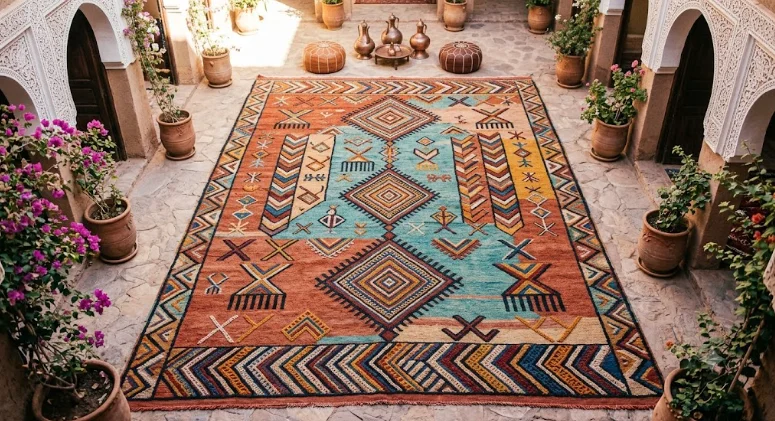
When you step onto an authentic hand-woven rug, learning to read Moroccan carpet patterns reveals a hidden history. You are not standing on simple decor. Instead, you are looking at an unwritten family manuscript. Amazigh (Berber) women have preserved these stories for generations across North Africa. Every geometric line, diamond, and chevron has a clear purpose. Together, they transform raw sheep wool into a narrative of fertility, protection, and spirituality.
Understanding traditional Moroccan carpet patterns requires a shift in perspective. Standard Western decor values symmetry, strict grids, and repetition. In contrast, traditional Amazigh weaving celebrates asymmetry and abstraction. Geometry acts as a sacred visual language. Whether you want to style a room or explore North African markets, decoding these ancient symbols changes how you see these textiles.
The Sacred Origins of Amazigh Weaving Traditions
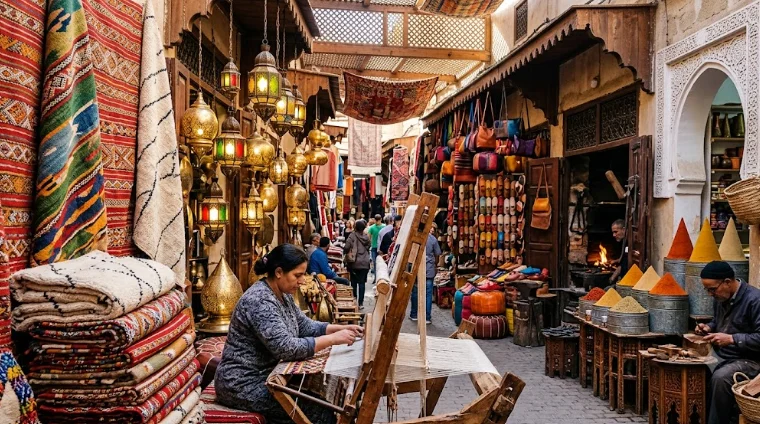
To understand these motifs, one must first meet the weavers. Rural Amazigh women in the Atlas Mountains crafted carpets mainly for daily life. Heavy wool rugs provided essential insulation during freezing winters. They also served as bedding, cushions, and tent dividers for nomadic tribes.
The Tamazight language relied historically on oral storytelling rather than written books. Consequently, regional Moroccan carpet patterns became a vital visual medium. A weaver’s loom acted as her personal diary and sanctuary.
+-----------------------------------------------------------------------+
|                    THE DUAL NATURE OF AMAZIGH WEAVING                 |
+-----------------------------------------------------------------------+
                                    |
          +-------------------------+-------------------------+
          |                                                   |
  [ PRACTICAL UTILITY ]                              [ SPIRITUAL & ARTISTIC ]
  - Heavy insulation for winters                     - Manifestation of Baraka (blessings)
  - Nomadic bedding & tent dividers                  - Visual preservation of oral history
  - Protective flooring & cushions                   - Warding off negative energy (Evil Eye)
Furthermore, weaving is closely linked to spiritual beliefs, especially Baraka (divine blessing). Before setting up the vertical loom, artisans frequently recite prayers. These blessings ward off malevolent forces (Jinn). As a result, protective Moroccan carpet patterns act as living talismans. They safeguard households, celebrate weddings, invoke rain, and protect children.
Decoding Common Moroccan Carpet Patterns and Symbols
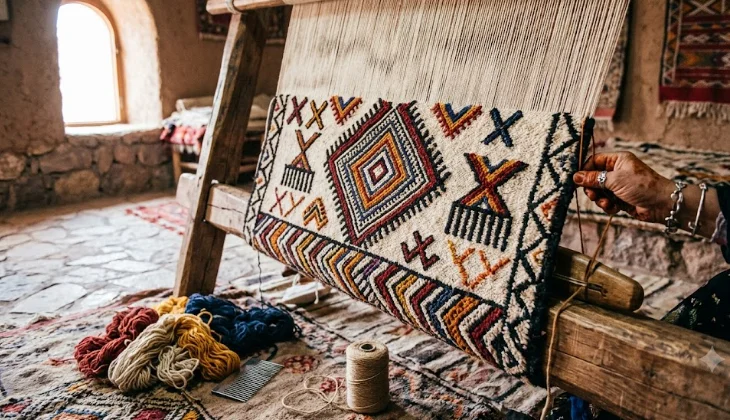
Every regional tribe speaks its own visual dialect. However, a shared alphabet of shapes connects these traditions. Here is how you can read the most common motifs.
       /\            /\            /\
      /  \          /  \          /  \
     /    \        /    \        /    \
    /  /\  \      /  /\  \      /  /\  \
   /  /  \  \    /  /  \  \    /  /  \  \
  /  /____\  \  /  /____\  \  /  /____\  \
 /____________\/____________\/____________\
1. The Diamond (Lozenge) in Moroccan Carpet Patterns
The diamond is the most universal motif in North Africa. It appears prominently in the famous plush rugs of the Middle Atlas.
- Symbolic Meaning: Represents female fertility, womanhood, and maternal protection.
- Cultural Context: An open diamond symbolises fertility and readiness for marriage. Conversely, a closed diamond protects an unborn child or a home.
2. The Zigzag and Chevron
Angular, continuous lines cut across high-pile and flatweave rugs alike.
- Symbolic Meaning: Represents flowing water, rain, and life-giving energy.
- Cultural Context: Artisans often weave zigzags along outer borders. Therefore, these lines act as protective barriers that keep good energy inside the room.
3. The Cross and Plus Motif
Intersecting lines appear strategically across asymmetrical designs.
- Symbolic Meaning: Defense against the Evil Eye (Ain) and spatial grounding.
- Cultural Context: Regional beliefs suggest that bad luck travels in straight paths. Consequently, a cross breaks up these lines and neutralises harmful energy.
4. The Comb (Mchot)
Resembling a rake or a multi-toothed tool, this motif honors the loom itself.
- Symbolic Meaning: Structure, domestic order, discipline, and stability.
- Deeper Significance: Weavers use heavy combs to pack wool knots tightly. Thus, the symbol represents hard work and family unity.
5. The Spider and the Scorpion
These creatures might intimidate Western buyers. However, their geometric forms carry protective powers.
- Symbolic Meaning: Defense against physical danger and venomous bites.
- Cultural Context: This practice stems from an ancient belief. Weaving the image of a threat prevents the real creature from entering the home.
Regional Styles: How Geography Dictates Moroccan Carpet Patterns
Morocco’s climate varies greatly, from snowy mountains to dry deserts. This geography directly shapes wool thickness, pile height, dyes, and Moroccan carpet patterns.
| Rug Type | Geographic Origin | Primary Visual Characteristics |
| Beni Ourain | Middle Atlas | Long ivory pile, minimal charcoal lines |
| Azilal | High Atlas | Short white wool pile, colorful symbols |
| Boujaad | Haouz Plains | Deep warm reds, pinks, fluid geometry |
| Boucherouite | Rural Communities | Recycled fabric scraps, vivid mosaics |
| Zanafi & Hanbel | Southern Atlas / Desert | Flatweave, tight chevrons, saw-teeth |
Beni Ourain: Minimalist Mountain Moroccan Carpet Patterns
The Beni Ourain confederation includes 17 tribes in the Middle Atlas. To survive harsh winters, they craft thick rugs from luxurious virgin wool.
- Pattern Style: Delicate dark lines form large diamonds over a un-dyed cream background.
- Modern Appeal: Their minimalist lines fit seamlessly into modern Scandinavian interiors.
Azilal: Vibrant Abstract Narratives
Originating in the High Atlas, Azilal carpets show remarkable artistic freedom. Weavers combine white virgin wool with brightly dyed cotton or wool threads.
- Pattern Style: Expressive layouts showcase human shapes, scattered diamonds, and colorful dots against an ivory base.
Boujaad: Earthy Warmth of the Plains
Crafted in the Haouz plains, Boujaad rugs feature rich, warm tones. Artisans use madder root, saffron, and henna for natural color.
- Pattern Style: Softened geometric shapes blend with fluid lines. In addition, deep reds, pinks, and purples create glowing visual fields.
Boucherouite: Sustainable Eco-Artistry
Resourceful weavers created Boucherouite rugs when wool was scarce. The name comes from boucherwit, meaning discarded clothing.
- Pattern Style: Artisans knot these rugs entirely from recycled fabric scraps, creating textured, colorful mosaics.
If you plan to visit these regions, explore our Atlas Mountains travel guide to connect with authentic cooperatives.
Color Symbolism in Moroccan Carpet Patterns
Color selection in traditional weaving is never accidental. Before synthetic dyes arrived, weavers relied on local plants and minerals. Each shade carries cultural weight:
- Red: Sourced from madder root, red represents vitality, strength, and warmth.
- Yellow: Harvested from saffron or turmeric, yellow symbolises joy and sunshine.
- Blue: Extracted from indigo, blue signifies peace, wisdom, and intuition.
- Green: Made from alfalfa or mint, green represents nature and healing.
- White / Cream: Natural sheep wool symbolises purity, peace, and divine grace (Baraka).
- Black / Dark Brown: Sourced from dark sheep fleece, these tones provide grounding contrast.
How to Read Moroccan Carpet Patterns Like a Storybook
An authentic rug reads sequentially from the bottom edge upward. This orientation reflects the weaver’s life journey during creation.
       TOP OF THE CARPET
[ Maturity / Spiritual Reflection ]
                |
[  Marriage & Motherhood Era     ]
                |
[  Girlhood / Unmarried Days     ]
      BOTTOM OF THE CARPET
- The Base (Girlhood & Early Youth): Lower fringes feature simpler designs that symbolise youth and learning the craft.
- The Center (Marriage & Life Transitions): As the rug grows, complex diamonds and combs appear. These motifs reflect courtship, marriage, and home life.
- The Top (Maturity & Reflection): Near the top, patterns become wider or shift shape, marking motherhood and spiritual peace.
Human life is unpredictable, and weavers reflect this reality. An artisan might alter a pattern or change dyes mid-way through her work. Such shifts document drought, birth, or personal change. Therefore, these organic variations prove that a rug is genuinely human.
Authentic Moroccan Carpet Patterns vs. Factory Machine Imitations
Factory-made copies have flooded the market as demand grows. To protect your investment, consider these key differences:
| Design Feature | Authentic Handmade Moroccan Carpet | Factory Machine-Made Copy |
| Pattern Geometry | Intentionally asymmetrical with human variations | Perfectly symmetrical, repeating digital grid |
| Fringe Construction | Integrated warp threads (often knotted on one end) | Uniform fringe sewn mechanically on both ends |
| Underside View | Irregular knot structure with tension shifts | Smooth, rigid, plastic mesh backing |
| Materials | 100% natural virgin wool, cotton, or goat hair | Synthetic materials (polypropylene, acrylic) |
| Color Depth | Rich tonal variations (abrash) from natural dyes | Flat, uniform colors across the surface |
When shopping in the souks of Marrakech, flip the carpet over. The back reveals the true story of the loom. Irregular knots confirm genuine craftsmanship.
Frequently Asked Questions
What do the symbols in Moroccan carpet patterns mean?
They form an ancient geometric language. Common symbols include diamonds for fertility, zigzags for water, combs for domestic order, and crosses for protection.
Why are traditional Moroccan carpet patterns asymmetrical?
Weavers work freehand without rigid blueprints. They adapt patterns as they progress, adjusting motifs to match personal events and emotions.
How can I spot authentic Moroccan carpet patterns versus synthetic copies?
Handmade rugs feature subtle pattern shifts, integrated fringes, and irregular knots underneath. Machine-made copies show digital symmetry and plastic backings.
What is the story behind Beni Ourain Moroccan carpet patterns?
Beni Ourain tribes developed these rugs in the snowy Middle Atlas. They feature simple dark charcoal diamonds over thick, natural cream wool.
Do Moroccan carpet patterns hold religious significance?
While motifs invoke protection and divine blessing (Baraka), most shapes predate modern history. They root deeply in ancient tribal heritage and nature.
How should I clean a handmade rug featuring Moroccan carpet patterns?
Vacuum gently using suction only. Blot spills immediately with a towel and mild wool soap. Avoid harsh chemicals or soaking vintage wool.