

Thuya Wood Essaouira: Secrets to the Best Souk Finds
- Home Décor & Traditional Crafts Moroccan Crafts
 Maroc Fans
- 0
- 20 minutes read

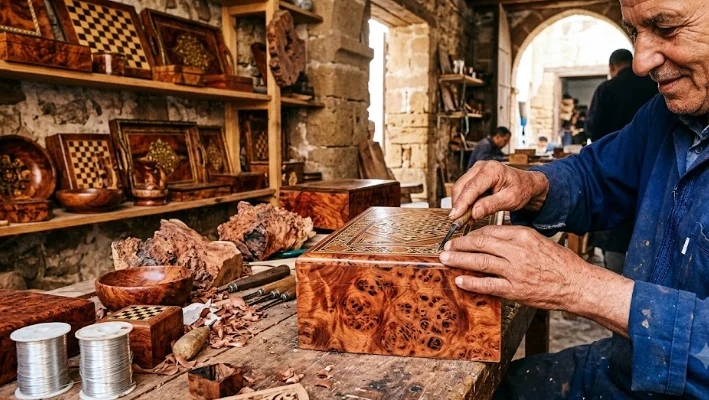
Walking through the vaulted stone passageways of Essaouira’s historic Medina, a distinct sensory experience greets every visitor long before they step into an artisan’s workshop. Indeed, it is the warm, cedar-like, spicy perfume of Thuya wood drifting from the carpentry ateliers beneath the city’s coastal ramparts.
For centuries, the coastal town of Essaouira—formerly known as Mogador—has stood as the world epicenter for masterfully carved Thuya wood products. Renowned for its rich reddish-brown hues, intricate bird’s-eye grain patterns, and remarkable durability, this precious timber is transformed by master craftsmen into world-class marquetry, furniture, secret puzzle boxes, and sculptured artifacts.
Whether you are a collector of fine handcrafted goods, a cultural traveler visiting Morocco, or an interior decor enthusiast, this comprehensive guide delves deep into the history, raw materials, crafting techniques, and sustainable future of Thuya wood.
1. What is Thuya Wood? Understanding Morocco’s Precious Timber
Thuya wood comes from Tetraclinis articulata, an evergreen coniferous tree belonging to the cypress family (Cupressaceae). Locally known in Arabic as Arar (عَرَعَار), this rare species is native to the western Mediterranean basin. Consequently, the overwhelming majority of the world’s viable forests grow naturally in Morocco’s Western High Atlas Mountains and the coastal hinterlands surrounding Essaouira.
                 +---------------------------------------+
                 |       Tetraclinis articulata          |
                 |          (The Thuya Tree)             |
                 +-------------------+-------------------+
                                     |
           +-------------------------+-------------------------+
           |                                                   |
           v                                                   v
  +------------------+                               +------------------+
  |    The Trunk     |                               |  The Root Burl   |
  | (Golden-Reddish) |                               |     (Arar)       |
  +--------+---------+                               +--------+---------+
           |                                                   |
           v                                                   v
• Straight, clean grain                         • Swirling "bird's-eye" knots
• Structural foundation                         • High concentration of natural oils
• Used for box bases & furniture legs           • Used for luxury veneers & inlays
The Trunk vs. The Root Burl (Arar)
Artisans in Essaouira categorize Thuya wood into two distinct working materials:
- The Trunk Wood: This section displays a lighter, warm golden-amber to reddish color with straight, clean lines. Furthermore, because it is strong and resilient, craftsmen frequently utilize it as the solid structural core for larger furniture pieces, box frames, and carved utensils.
- The Root Burl (Arar): This part represents the true jewel of Moroccan woodworking. Beneath the soil, the tree forms bulbous, dense root growths known as burls. Stressed by rocky soil and dry coastal weather, these burls develop twisted grain structures peppered with small, dark cluster points reminiscent of peacock feathers or wild cat spots. In addition, Thuya wood root burl is exceptionally dense, heavily saturated with natural essential oils, and produces a mirror-like sheen when polished.
Because root burl grows underground over decades or centuries, every single slice of Thuya wood burl exhibits a completely unique, non-repeating pattern.
2. The History of Thuya Woodworking in Essaouira
The connection between human civilization and Thuya wood extends back thousands of years. In fact, ancient Roman elites highly prized luxury tables made from North African burl, which they referred to as citron wood. Historical accounts record that wealthy Romans, including Cicero and Julius Caesar, spent fortunes acquiring dining tables crafted from single slabs of raw Thuya wood roots.
The Rise of Mogador Marquetry
During the 18th century, under the reign of Sultan Mohammed ben Abdallah, Mogador (now Essaouira) was established as Morocco’s premier international trading port. To decorate royal palaces and diplomatic gifts, the Sultan brought skilled woodworkers, marquetarians, and carvers from across the realm to work with native Thuya wood.
Over generations, family lineages of wood artisans (Maâlems) settled into the workshops built directly into the thick stone ramparts of the Sqala de la Kasbah. Eventually, these master carvers perfected the art of Moroccan marquetry by blending indigenous Amazigh geometric motifs with Andalusian and European inlay traditions.
3. The Craftsmanship Process: From Raw Root to Masterpiece
Creating artisanal Thuya wood items in Essaouira is a time-intensive process demanding years of specialized training, physical strength, and surgical accuracy.
Step 1: Harvesting and Curing the Burl (Duration: 1 to 3 Years)
Raw timber cannot be used immediately after extraction because freshly dug root burls contain high moisture levels. Therefore, artisans cut the raw burl into thick slabs. Next, they store them in dark, ventilated cellars for one to three years to slowly dry. As a result, proper curing prevents cracking, warping, or splitting after the piece is finished.
Step 2: Shaping and Base Construction (Precision Joinery)
Afterward, the artisan selects suitable dry slabs and cuts them to shape using hand saws and lathes. For complex items like jewelry boxes or tables, the structural frame is assembled using traditional joinery methods to ensure long-term stability.
Step 3: Inlay and Marquetry / Incrustation (Delicate Patterning)
Using fine hand saws, the craftsman cuts delicate channels into the Thuya wood surface. Subsequently, they meticulously insert contrasting materials—such as lemonwood, ebony, or mother-of-pearl—to form geometric starbursts, Arabesques, or floral motifs.
Step 4: Sanding and Refinement (Progressive Smoothing)
In the next stage, the object undergoes successive rounds of manual sanding with progressively finer grits. Consequently, this meticulous step removes all ridges between the Thuya wood and the delicate inlays until the entire surface becomes completely flush and smooth to the touch.
Step 5: Polishing and Natural Finishing (Releasing the Aroma)
Unlike modern industrial items finished with thick synthetic lacquers, authentic Thuya crafts are hand-polished using natural sealers. Typically, a mixture of natural alcohol and Sandarac resin (or organic beeswax) is rubbed into the grain using felt pads. Ultimately, this process elevates the deep red tones while locking in the wood’s aromatic fragrance.
4. Popular Types of Thuya Wood Crafts Made in Essaouira
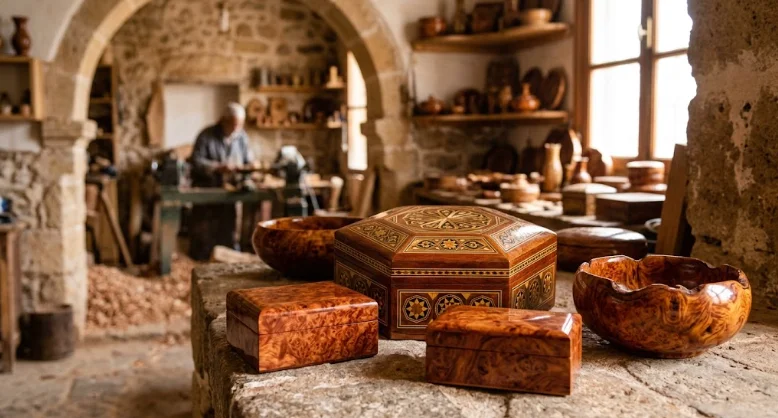
Visiting an artisan shop in Essaouira presents a rich array of hand-carved goods. Below are the most sought-after Thuya wood items:
| Craft Category | Typical Features & Design | Common Inlay Materials |
| Traditional & Magic Puzzle Boxes | Hidden sliding panels, secret locking mechanisms, and velvety interiors. | Lemonwood, Ebony, Mother-of-Pearl |
| Decorative Serving Trays | Solid handles, high-contrast geometric marquetry bases. | Silver wire, Lemonwood strips |
| Handcrafted Game Sets | Chessboards, backgammon boards, and polished playing pieces. | Ebony vs. Lemonwood squares |
| Fine Furniture | Coffee tables, desks, mirrors, and sculptured side tables. | Intricate full-surface Thuya wood burl veneers |
| Sculptures & Kitchenware | Salad bowls, serving spoons, stylized animal figurines, and trinket bowls. | Pure Thuya wood burl (minimal or no inlays) |
5. How to Identify Authentic, High-Quality Thuya Wood
Due to the global reputation of Thuya wood, counterfeit or lower-grade imitation items exist in tourist markets. However, buyers can use the following checks to confirm they are purchasing authentic, master-crafted pieces:
- The Aromatherapy Test (The Scent): Genuine Thuya wood possesses an undeniable natural fragrance—a warm blend of cedar, wild pine, and crushed pepper. Conversely, if a piece smells purely of synthetic chemical varnish or has no scent at all, it may be a different wood stained to look like Thuya. Gently rubbing the unvarnished bottom or interior of a box with your thumb will release a fresh burst of natural essential oils.
- Weight and Density: Thuya wood burl is remarkably dense and heavy. For instance, an authentic small jewelry box feels surprisingly heavy in the palm compared to cedar or pine boxes of similar dimensions.
- Grain Imperfections: Because burl is a natural root formation, no two sections look identical. Furthermore, examining the “eyes” (dark clusters) reveals organic variations in dot size, spacing, and grain direction. On the other hand, perfectly uniform, repeating patterns usually indicate printed laminate veneers.
- Flush Joints: Run your fingertips over the inlaid geometric patterns. Master marquetarians in Essaouira sand their pieces so smoothly that you cannot feel any physical seam or bump between the Thuya wood base, the lemonwood, or the mother-of-pearl.
6. Sustainability and Environmental Conservation
The rising popularity of Moroccan crafts globally has placed environmental responsibility at the center of woodworking. Because Tetraclinis articulata grows slowly and is largely endemic to North Africa, sustainable forest management is critical to preserve Thuya wood for future generations.
Forestry Regulations and Reforestation
To protect the ecosystem, the Moroccan Ministry of Agriculture and Forestry works alongside local artisan cooperatives in Essaouira to enforce strict logging guidelines:
- Permit Systems: Craftsmen must purchase Thuya wood timber sourced exclusively from designated, state-managed forestry zones.
- Root Extraction Focus: Artisans prioritize dead or aged root burls excavated from fallen trees, thereby minimizing damage to live, young stands.
- Active Reforestation: Environmental initiatives across the Western High Atlas regularly plant thousands of new saplings to ensure future ecological balance.
Ultimately, buying directly from recognized artisan cooperatives (coopératives artisanales) in Essaouira ensures that your purchase supports fair wages for local families as well as legal, environmentally sound timber practices.
7. Caring for Your Thuya Wood Pieces at Home
Items crafted from Thuya wood can last for generations when cared for correctly. To maintain the natural luster and aromatic properties of your pieces, keep the following conservation tips in mind:
- Keep Away from Direct Sunlight: Prolonged exposure to harsh UV rays can dry out the natural root oils. As a result, the rich red hues may fade to a dull yellow-brown.
- Avoid Water and Excess Humidity: Never submerge Thuya wood items in water or place them in dishwashers. Instead, clean serving trays or bowls with a damp cloth and dry them immediately.
- Nourish with Natural Oils or Wax: Once or twice a year, apply a light coat of natural beeswax or vegetable-based wood polish using a soft microfiber cloth. Allow it to absorb for 15 minutes, then buff lightly.
- Revive the Natural Scent: If your box loses its fragrance over time, lightly scrape an unpolished interior corner with a fine fingernail file. This action opens up the wood pores and releases fresh aromatic resin.
Discover More on MarocFans
- Explore the Coastal Charm of Essaouira: Top Things to Do in Mogador (Internal Link Placeholder)
- The Ultimate Guide to Shopping in the Souks of Marrakech (Internal Link Placeholder)
- Traditional Moroccan Handicrafts: Leather, Pottery, and Zellige Explained (Internal Link Placeholder)
- A Traveler’s Guide to Sustainable Tourism and Artisan Cooperatives in Morocco (Internal Link Placeholder)
Frequently Asked Questions (FAQ)
1. Why is Thuya wood found primarily in Essaouira?
The Tetraclinis articulata tree thrives specifically in the microclimate of the coastal High Atlas region surrounding Essaouira. Additionally, the city has cultivated centuries of specialized marquetry knowledge, establishing a dense network of master craftsmen and specialized workshops unmatched anywhere else in the world.
2. Is Thuya wood durable?
Yes, absolutely. Thuya wood burl is dense, hard, and naturally resistant to rot and insect infestation due to its high concentration of natural aromatic resins and oils. Thus, well-maintained pieces easily survive for generations.
3. How can I tell if my item uses real Thuya wood burl?
Real burl wood features swirling grain patterns, dense cluster points (known as “eyes”), and natural variations in shade. Furthermore, it feels heavy and smooth to the touch while releasing a distinct cedar-peppery fragrance when rubbed.
4. What is a Moroccan “Magic Box”?
A Moroccan Magic Box is a traditional puzzle box handcrafted in Essaouira from Thuya wood. It features hidden keyholes, sliding wooden panels, or concealed release buttons built directly into the marquetry pattern, requiring a specific sequence of secret steps to open.
5. Why do Thuya wood crafts vary significantly in price?
Prices vary based on several factors, including the proportion of rare root burl used versus trunk wood, the complexity of the hand-carved inlays (lemonwood, ebony, or mother-of-pearl), the physical size of the piece, and the overall reputation of the artisan or cooperative.
6. Can I use Thuya wood bowls and utensils for food?
Yes, provided they are raw or finished with food-safe natural waxes and oils. However, you should avoid using Thuya wood bowls for hot liquids or soups, as heat can leach out the strong natural resins and alter the taste of food. Consequently, they are ideal primarily for dry snacks, nuts, bread, or salads.
7. Is buying Thuya wood products environmentally friendly?
Yes, especially when purchased from licensed artisan cooperatives that adhere to government forestry regulations. Morocco strictly controls timber harvesting and mandates active reforestation programs to preserve the species long-term.