

Moroccan Pottery: Secrets to the Ultimate Shopping
- Moroccan Crafts Pottery & Zellige
 Maroc Fans
- 0
- 22 minutes read

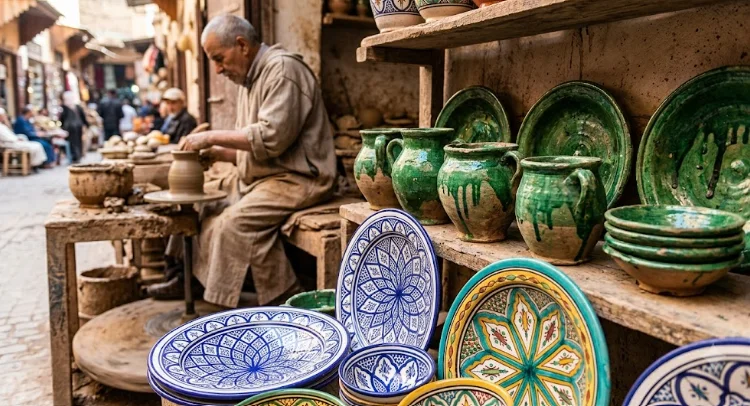
When walking through the winding alleyways of a Moroccan medina, few sensory experiences captivate travelers quite like handcrafted ceramics. Stacked high in bustling souks or gleaming under the sun, authentic Moroccan pottery is much more than mere kitchenware or home decoration. Indeed, it represents a living art form, a historical vessel, and a cornerstone of the nation’s rich cultural identity.
From the deep cobalt blues of Fes to the sun-drenched terracottas of Safi, every hand-thrown pot tells a story. In this guide, we explore the rich history of Moroccan pottery, break down the distinct regional styles, reveal how authentic pieces are made, and share insider tips on where to buy real ceramics locally and online.
The Ancient Roots of Moroccan Pottery
The story of ceramics in North Africa spans thousands of years. Over time, it evolved through a blend of indigenous traditions, foreign influences, and ancient trade routes across the Mediterranean.
       [ Amazigh (Berber) Roots ]
       - Hand-molded terracotta
       - Geometric tribal symbols
                  │
                  ▼
       [ Arab-Andalusian Influence ] (9th–15th Century)
       - Introduction of glazes & cobalt blue
       - Complex Islamic geometric art
                  │
                  ▼
   [ Modern Regional Ceramic Capitals ]
   Fes • Safi • Tamegroute • Rif Mountains
Indigenous Heritage in Moroccan Pottery
Long before glazes and high-temperature kilns arrived in North Africa, local Amazigh (Berber) communities crafted functional earthenware from riverbed clay. Primarily hand-molded by rural women without a potter’s wheel, these early examples of Moroccan pottery were built strictly for utility. For example, people used them to store water, preserve olive oil, and cook meals over open fires. Furthermore, decorative elements relied on burnishing with river stones or painting simple geometric symbols using natural pigments.
Arab-Andalusian Influences
Between the 8th and 15th centuries, waves of Arab settlers and Andalusian refugees brought advanced technology to North Africa. Consequently, they introduced several game-changing innovations to local craftsmen:
- The Potter’s Wheel: This tool allowed for faster and far more symmetrical creation.
- Glazing Techniques: Artisans began using tin and lead glazes to produce bright, glossy surfaces.
- Islamic Geometry: Craftsmen shifted motifs toward detailed floral Arabesques, star polygons, and elegant calligraphy.
As a result, this cultural fusion transformed simple rural cookware into a world-renowned craft lauded for its artistic complexity. To understand how these traditions fit into broader regional craftsmanship, explore our detailed guide on traditional decor and artisan crafts.
Regional Styles of Moroccan Pottery
While handcrafted ceramics are produced throughout the country, four distinct regions hold legendary status for their unique techniques, colors, and aesthetics.
| Region | Primary Style / Glaze | Key Features | Common Uses |
| Fes | Tin-glazed earthenware, Cobalt Blue (Bleu de Fès) | Fine detail, intricate geometric patterns, white background | Decorative plates, serving bowls, urns, tilework (zellige) |
| Safi | Multicolored glazed ceramics | Vibrant yellows, greens, and blues; modern & traditional mix | Serving platters, tagines, decorative jars |
| Tamegroute | Rustic copper-manganese glaze | Earthy emerald green, raw texture, drip marks | Decorative vases, candlesticks, rustic tableware |
| Rif Mountains | Raw terracotta with natural mineral paint | Un-glazed or burnished, female-crafted, tribal line art | Water jugs, cooking pots, traditional bowls |
1. Fes: Classical Blue Moroccan Pottery
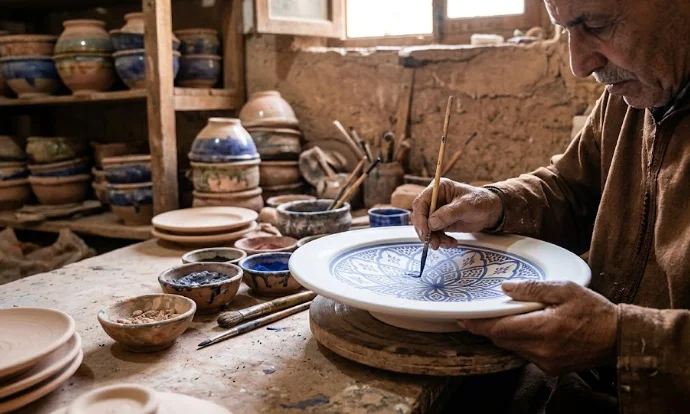
Fes is widely considered the artistic heartland of traditional craftsmanship. Renowned for its refined technique, ceramics from Fes are immediately recognizable by their stark white tin-glazed background adorned with delicate geometric patterns.
- The Famous Bleu de Fès: The signature vibrant blue pigment traditionally comes from local cobalt oxide mined in the Atlas Mountains.
- Precision Craftsmanship: Master artisans spend years mastering the balance of symmetry required for classical Islamic patterns (zillij motifs).
- Double Firing Method: Pieces are fired once as plain clay (biscuit), hand-painted with ox-hair brushes, glazed, and then fired a second time at high temperatures.
Artisan Fact: Traditional master potters in Fes use fine ox-hair brushes attached to bird feathers. This allows them to paint microscopic lines with extraordinary accuracy.
2. Safi: The Ceramic Capital
Located along the Atlantic coast, the port city of Safi produces the vast majority of glazed tableware today. In the mid-19th century, master potters from Fes migrated to Safi, establishing what is now known as La Colline des Potiers (The Potters’ Hill).
Unlike Fes’s strict blue-and-white tradition, Safi potters embraced bold polychrome color palettes. For instance, they frequently incorporate ochre yellow, turquoise blue, vibrant green, and deep red. Today, Safi serves as the main testing ground where traditional motifs blend seamlessly with modern trends.
3. Tamegroute: Green Moroccan Pottery
Tucked away at the edge of the Sahara Desert in the Draa Valley lies the small village of Tamegroute. Here, seven artisan families pass down a secret glaze recipe that produces one of the world’s most captivating aesthetics.
- Unique Glaze Recipe: Craftsmen use a precise mix of copper (which gives the green hue), silicon, manganese, and barley flour.
- Underground Kilns: Artisans fire the clay in ancient subterranean kilns fueled by wood. Consequently, uneven heat and flying ash create natural variations, tiny imperfections, and striking drip marks.
- Earthy & Raw Appeal: These raw examples of Moroccan pottery feature an unpolished, tactile beauty heavily favored by interior designers seeking organic luxury.
4. Rif Mountains: Tribal Female Heritage
In the northern mountains, rural Amazigh women maintain an ancient tradition that predates glaze technology altogether.
- Hand-Sculpted Without Wheels: Pots are shaped using smooth river stones, wooden paddles, and raw clay dug directly from nearby hillsides.
- Natural Mineral Painting: After sun-drying, women paint the surfaces with dark red or black lines made from local rock minerals and plant extracts.
- Eco-Friendly & Functional: Un-glazed and fired in open wood pits, these vessels remain highly breathable. Therefore, they are ideal for natural water-cooling containers and cooking pots.
If you are planning a cultural tour across these regions, check out our guide on how to navigate local souks to make the most of your trip.
Crafting Authentic Moroccan Pottery
Understanding the physical labor involved in creating handmade Moroccan pottery helps explain why these pieces are so deeply cherished.
[1. Clay Prep] ➔ [2. Throwing/Molding] ➔ [3. Sun Drying] ➔ [4. First Firing] ➔ [5. Hand Glazing] ➔ [6. Second Firing]
- Clay Extraction & Soaking: First, workers mine raw clay locally and soak it in large open pits. Then, they manually tread it underfoot to remove air bubbles.
- Throwing and Shaping: Next, artisans use foot-powered potter’s wheels to shape the clay with remarkable speed and precision.
- Sun Drying: Newly shaped vessels dry under the sun for several days until leather-hard.
- The First Firing: Afterwards, the dried clay is loaded into traditional kilns and baked at high temperatures.
- Hand Glazing & Painting: Subsequently, painters add complex freehand motifs directly onto the porous clay using natural mineral pigments.
- The Second Firing: Finally, the painted ceramic receives a clear enamel glaze coat and undergoes a second firing, transforming raw earth into a shiny masterpiece.
Where to Buy Authentic Moroccan Pottery
Whether traveling abroad or shopping remotely, knowing where to find genuine hand-crafted items—and how to separate them from cheap factory knockoffs—is essential.
       ┌──────────────────────────────────────────────┐
       │         Where to Buy Authentic Pieces        │
       └──────────────────────┬───────────────────────┘
                              │
         ┌────────────────────┴────────────────────┐
         ▼                                         ▼
   [ In Morocco ]                            [ Online ]
   • Fes Pottery Village (Ain Nokbi)         • Verified Artisan Marketplaces
   • Safi Potters' Hill                      • Direct Fair-Trade Imports
   • Marrakech Medina Souks                  • Specialized Boutiques
Top Locations to Buy Moroccan Pottery
- Fes (Ain Nokbi Pottery Village): Located just outside the historic medina walls, Ain Nokbi is a dedicated artisan district. Visitors can observe potters working clay, painting plates, and firing kilns. Moreover, buying directly from cooperative workshops ensures fair wages for the makers.
- Safi (Colline des Potiers): Safi offers the largest concentration of workshops in the country. Head to Potters’ Hill overlooking the ocean to browse hundreds of stalls filled with platters and vases at direct prices.
- Marrakech (Souk Semmarine & Ensemble Artisanal): If your itinerary is limited to Marrakech, visit the Ensemble Artisanal for fixed-price, government-regulated shopping. Alternatively, explore Souk Semmarine for a classic bargaining experience.
Planning a trip? Don’t miss our complete Marrakech shopping guide for insider travel tips.
Identifying Real Moroccan Pottery vs. Knockoffs
As popular demand rises, cheap mass-produced knockoffs have entered mainstream markets. Fortunately, you can use this simple checklist to identify authentic handmade Moroccan pottery:
- Weight & Texture: Real terracotta pieces feel substantial and organic. Therefore, look for subtle variations in weight and slight irregularities on the base.
- Brushwork Details: Hand-painted lines show tiny variations in thickness and pigment. In contrast, uniform print-like symmetry often indicates a factory decal.
- Kiln Marks: Genuine pieces fired in traditional kilns frequently have small unglazed points on the bottom where they sat during firing.
- Artisan Signatures: Master painters often etch or paint their mark onto the underside of large decorative platters.
Essential Care & Safety Guidelines
When purchasing serving bowls, tiles, or cooking tagines, keep these practical guidelines in mind:
Food Safety in Moroccan Pottery
Historically, some dark glazes relied on lead oxides to lower firing temperatures. While decorative pieces of Moroccan pottery are perfectly safe for display, you should always ensure items intended for food are explicitly labeled lead-free and food-safe.
Important Note: Cooking tagines should feature plain unglazed clay or certified food-safe glazes. Learn how to select, season, and cook with authentic items in our guide to traditional tagines.
Maintenance Tips
- Avoid Thermal Shock: Never place a cold ceramic dish directly into a preheated oven. Similarly, do not wash a hot tagine with cold water, as thermal shock causes cracking.
- Hand Wash Only: High-heat dishwashers and harsh detergents dull hand-painted glazes over time. Instead, hand-wash with mild soap and warm water.
- Allow Proper Drying: Make sure unglazed or rustic pieces dry completely in a well-ventilated area before storing to prevent moisture buildup.
Frequently Asked Questions
1. What makes Moroccan pottery so famous worldwide?
Handcrafted Moroccan pottery is celebrated for its blend of ancient Amazigh techniques and complex Islamic artwork. Each piece is thrown on a wheel, painted freehand with mineral pigments, and twice-fired using traditional methods.
2. What is the difference between Fes and Safi ceramics?
Fes ceramics are famous for fine, intricate geometric painting on a white background, primarily using cobalt blue. On the other hand, Safi ceramics feature vibrant, multicolored palettes and broader artistic motifs.
3. Is Tamegroute green pottery safe for food serving?
Most Tamegroute pieces are crafted primarily for decorative use or dry food storage. Due to traditional glaze compositions, it is recommended to verify food-safety certifications with the seller before using them for hot liquids or acidic foods.
4. Can I use a glazed tagine for cooking?
Not all glazed tagines are safe for stovetop heat. In fact, many glazed dishes sold in souks are intended purely for serving. For cooking over a flame, always choose an unglazed, heavy-duty clay cooking tagine.
5. How do I safely pack ceramics when traveling?
Wrap each piece individually in thick layers of bubble wrap or heavy clothing. Furthermore, pack them tightly near the center of your suitcase so they cannot shift, or request double-boxed international shipping directly from workshops.
6. Why are there small imperfections on my pottery?
Small irregularities, subtle color variations, and tiny kiln marks on the base are natural characteristics of handmade ceramics. Rather than defects, these features confirm that your item was crafted by a human artisan.
7. How can I tell if a ceramic piece is hand-painted?
Examine the painted lines closely. Hand-painted pieces show subtle brushstrokes, slight variations in paint thickness, and faint pencil guidelines. In contrast, factory-made imitations feature smooth, uniform printed decals.
Final Thoughts
Handcrafted Moroccan pottery represents a bridge between earth, fire, history, and human creativity. Whether you choose a classic blue-and-white serving dish from Fes, a cheerful platter from Safi, or an earthy green vase from Tamegroute, bringing these treasures into your home supports vibrant artisan communities.