
Chouara Tannery in Fez: Secrets to the Best Visit
- Morocco Guide Travel Tips
 Maroc Fans
- 0
- 21 minutes read

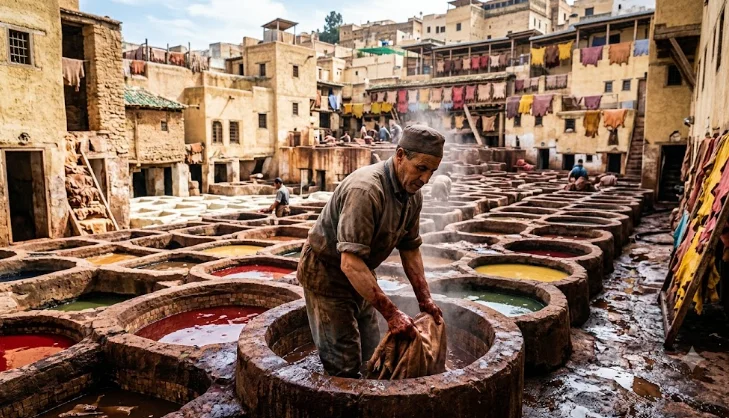
Visiting the Chouara Tannery in Fez is one of the most unforgettable experiences you can have while exploring Morocco. As you step into the labyrinthine alleyways of Fes el-Bali, the ancient UNESCO-listed medina, your senses will soon tell you that you are approaching something extraordinary. Long before you even see the famous honeycomb of stone vats, the earthy smell of raw hides and fresh mint hints at an ancient trade alive and thriving.
Welcome to Chouara Tannery in Fez (also spelled Chaouwara or Chouwara), which is the largest and oldest leather tannery in the city. Operating almost continuously since the 11th century, this historic site functions as a living museum where leather production has barely changed since medieval times.
Whether you are capturing incredible photos from a rooftop terrace, learning about traditional vegetable dyeing, or shopping for handmade Moroccan slippers, this complete guide covers everything you need to know before visiting.
Why Chouara Tannery in Fez is a Must-Visit Destination
Among the three traditional tanneries in Fez—the others being Sidi Moussa and Ain Azliten—Chouara is by far the largest, most famous, and most photogenic.
| Feature | Visitor Context |
| Location | Heart of Fes el-Bali (near Place Seffarine) |
| Established | 11th Century (Over 1,000 years old) |
| Primary Hides | Cow, Goat, Sheep, and Camel |
| Admission Fee | Free entry; 10–30 MAD tip expected for terraces |
| Best Time to Visit | 9:00 AM – 11:30 AM (Active work & fresh dyes) |
| Average Duration | 45 minutes to 1.5 hours |
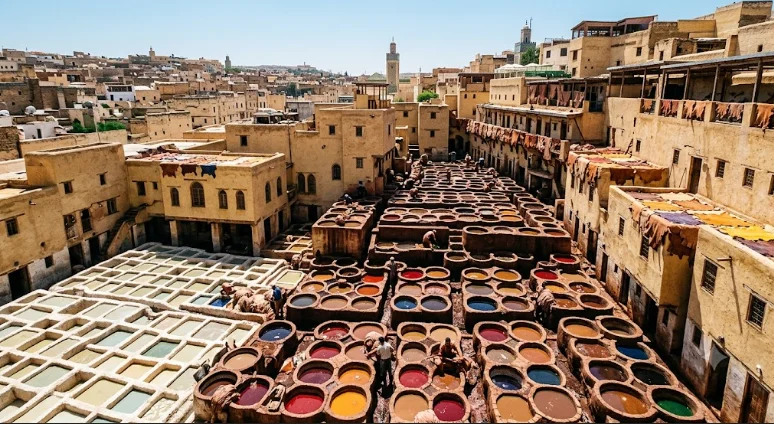
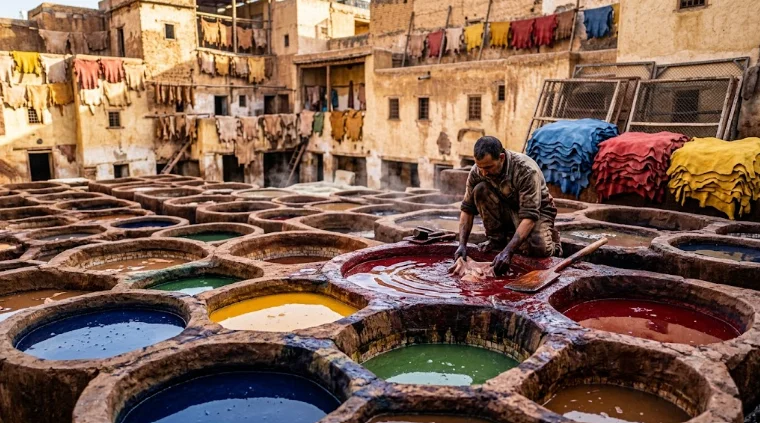
When you look down over the Chouara Tannery in Fez from a surrounding rooftop, the scene looks like a giant, chaotic watercolor palette. Dozens of round stone pits are filled with liquid dyes ranging from saffron yellow and rich terracotta red to dark indigo blue. Consequently, tanners stand knee-deep in these vessels, washing, stomping, and treating raw animal hides under the North African sun.
Ultimately, visiting Chouara Tannery in Fez is not just about taking pictures. Instead, it offers a rare encounter with an endangered art form preserved by generations of dedicated artisan families.
The History of Chouara Tannery in Fez: 1,000 Years of Heritage
Fez was founded in the late 8th century by Idris I, quickly becoming a major hub for trade, scholarship, and artisan guilds across North Africa. Naturally, leatherworking became one of the city’s primary industries. Historical records suggest Chouara Tannery in Fez was established during the 11th century under the Almoravid dynasty. It was positioned deliberately along the Oued Fes (Fez River) in order to secure a constant water supply necessary for leather processing.
By the 12th and 13th centuries, fine leather produced here was exported as far as Baghdad and across Europe. In fact, soft leather made from local goat skins became known internationally simply as “Morocco leather.”
Today, the master tanners (maalems) working at Chouara Tannery in Fez belong to ancient guilds. Because skills are passed down directly from father to son, they preserve this centuries-old heritage without relying on industrial machinery.
Step-by-Step: How Leather is Made at Chouara Tannery in Fez
The traditional process at Chouara Tannery in Fez relies entirely on natural ingredients, manual strength, and organic compounds. Indeed, no synthetic chemicals or modern machinery are used at any point.
Overall, the entire treatment takes between 20 to 45 days and follows four distinct stages:
The Tanning Process at a Glance:
1. Preparation (Salt & Lime vats) ──► 2. Softening (Pigeon dung bath) ──► 3. Natural Dyeing (Plant-based colors) ──► 4. Drying (Sun drying)
Stage 1: Cleaning & Unhairing in the White Vats
Raw hides from cows, goats, sheep, and camels arrive at the tannery where they are first salted to prevent decay. After that, workers submerge them in large white stone vats containing water, quicklime (calcium oxide), and cow urine. This harsh alkaline solution softens the tough hides while dissolving remaining hair, fat, and flesh over two to three days.
Stage 2: Softening & Kneading (Iferd)
Once stripped of hair, the hides move to a second set of vats containing a mixture of water, salt, and pigeon droppings. Because pigeon dung is naturally rich in ammonia, its enzymes break down rigid proteins in the hides. As a result, the leather becomes supple, durable, and capable of absorbing color dyes easily. Tanners climb into the waist-deep pits and stomp on the hides with their bare feet for hours. Unsurprisingly, this stage is the primary source of the tannery’s notorious odor!
Stage 3: Natural Dyeing at Chouara Tannery in Fez
After rinsing, the softened hides move to the colorful round vats. Notably, Chouara Tannery in Fez uses only natural pigments sourced from plants and minerals:
- Yellow: Saffron threads, turmeric, or pomegranate peel
- Red: Poppy flowers (coquelicot) or paprika
- Blue: Natural indigo plant leaves
- Green: Mint leaves combined with antimony
- Brown: Cedarwood bark or henna
- Black: Kohl or iron sulfate mixed with olive oil
The hides soak in these liquid mixtures while tanners manually knead them to ensure uniform color saturation.
Stage 4: Drying and Finishing
Finally, workers carry the dyed leather to nearby rooftops or hillside terraces so it can dry naturally under the hot Moroccan sun. Once completely dry, the leather is treated with olive or argan oil to restore suppleness before being delivered to local workshops.
How to Find Chouara Tannery in Fez
Navigating the medina of Fez can feel overwhelming due to its 9,000 car-free streets. However, reaching Chouara Tannery in Fez is quite straightforward if you follow key landmarks:
- Bab Boujeloud (Blue Gate): Start at the main entrance of Fes el-Bali.
- Talaa Kebira: Walk down the main thoroughfare running downhill through the medina.
- Place Seffarine: Continue past the Al-Qarawiyyin Library toward the iconic copper artisan market.
- Follow the Signs: Look for wall markings reading “Tanneries” or “Cuir.” Furthermore, as you get close, local shopkeepers will offer sprigs of fresh mint—a clear signal that you have arrived!
Practical Information for Visiting Chouara Tannery in Fez
Opening Hours and Timings
- Daily Hours: 8:30 AM to 7:00 PM
- Best Time to Visit: 9:00 AM – 11:30 AM. During these morning hours, artisans actively wash and dye hides, dye colors are fresh, and the midday heat has not amplified the smell yet.
- Friday Visits: Friday is a holy day in Islam. Therefore, while the site remains partially open, many artisans leave between 12:00 PM and 3:00 PM for prayers.
Entrance Fees & Terrace Access
- Official Entry Fee: Free. The site is an active workplace rather than a gated monument.
- Viewing Terraces: You cannot view the pits well from ground level. Instead, access is provided through surrounding multi-story leather shops.
- Tipping Expectations: Shopkeepers let you access their rooftop balconies for free with the hope that you will buy something. However, if you do not buy anything, it is customary to give a small tip of 10 to 30 MAD ($1 to $3 USD) per person to the assistant who led you upstairs.
Survival Tips for Visiting Chouara Tannery in Fez
To make the most of your excursion to Chouara Tannery in Fez, keep these key practical tips in mind:
1. Embrace Fresh Mint
When approaching shop entrances, staff will hand you a small sprig of fresh mint. Hold it directly under your nose while standing on the viewing terrace, as the strong menthol aroma effectively masks the smell of ammonia.
2. Wear Closed-Toe Shoes
If you plan to walk near ground-level areas, wear sturdy closed-toe shoes. After all, the surrounding lanes can be slippery with water and organic runoff.
3. Ask Before Photographing Workers
While panoramic terrace photos are welcome, taking direct close-up portraits of artisans working in the pits can feel intrusive. Therefore, always ask politely or offer a small tip (10–20 MAD) if a worker poses for your photo.
4. Watch Out for Common Scams
Because Chouara Tannery in Fez is one of Morocco’s top attractions, tourist hustles are common nearby.
- The “Tannery is Closed” Scam: Unofficial guides may claim the site is closed for a holiday, offering to take you to a “special alternative.” You can safely ignore them, as the tannery rarely closes completely during daytime hours.
- Unsolicited Guides: Young men may walk beside you and demand payment for guiding you. Politely but firmly say “La, Shukran” (No, thank you) as early as possible.
Shopping Guide at Chouara Tannery in Fez
Surrounding the Chouara Tannery in Fez are dozens of multi-level stores selling thousands of handcrafted items, including jackets, babouches (traditional slippers), leather poufs, and travel bags.
| Item Type | Typical Starting Price | Target Negotiated Price |
| Leather Babouches (Shoes) | 150 – 250 MAD | 80 – 120 MAD |
| Leather Pouf (Unstuffed) | 350 – 500 MAD | 200 – 300 MAD |
| Medium Leather Duffle Bag | 700 – 1,200 MAD | 400 – 600 MAD |
| Leather Jacket | 1,500 – 2,500 MAD | 900 – 1,400 MAD |
How to Inspect Leather Quality
First, smell the leather. High-quality vegetable-tanned leather smells earthy and rich. However, if it smells overwhelmingly like harsh chemicals, the tanning agent was not fully washed out. Additionally, check the stitching on seams and zippers to ensure the threads are tight and uniform.
Bargaining Tips
Bargaining is a normal and friendly part of Moroccan culture. As a general rule, start your offer at roughly 40% to 50% of the initial quote. Always remain polite and relaxed throughout the conversation. If you cannot reach a fair agreement, simply thank the seller and walk away; frequently, they will call you back with a better price.
Frequently Asked Questions About Chouara Tannery in Fez
1. Is Chouara Tannery in Fez free to visit?
Yes, there is no official entry fee. However, because the best views are from private leather shop terraces, you should expect to pay a small tip of 10 to 30 MAD per person if you do not purchase any goods.
2. How bad is the smell at Chouara Tannery in Fez?
The odor is strong due to the pigeon droppings and natural compounds used during softening. Nevertheless, holding fresh mint sprigs under your nose makes the experience completely manageable for most travelers.
3. Can you go down inside the tannery pits?
Generally, tourists stay on viewing terraces for safety and sanitary reasons. Although local guides can occasionally arrange ground-level access for a fee, viewing the site from above offers significantly better panoramic photos.
4. How does Chouara compare to tanneries in Marrakech?
The Chouara Tannery in Fez is much larger, older, more colorful, and better structured for visitors than the tanneries in Marrakech. Thus, Fez remains the premier destination to experience traditional Moroccan leather crafts.
Final Thoughts: Is Chouara Tannery in Fez Worth Visiting?
Without a doubt, visiting the Chouara Tannery in Fez is one of the most memorable sensory experiences in Morocco. Watching dedicated artisans practice a 1,000-year-old craft using traditional natural elements offers an unforgettable glimpse into the country’s living history.