

Snails in Marrakech: The Hidden Medicinal Broth Locals Love

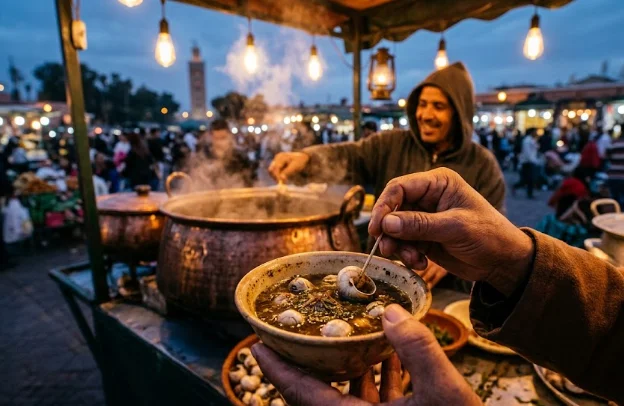
When the sun sets in the Red City, Jemaa el-Fnaa square transforms into a massive open-air restaurant. Amidst the smoke of grilled meats and the aroma of mint tea, one unique dish stands out. Trying the famous snails in Marrakech is an absolute must for adventurous foodies.
Known locally as Babbouche or Ghlal, this street food is deeply traditional. It is far removed from the buttery, garlic escargot of a Parisian bistro. Instead, this heavily spiced dish has warmed the bellies of locals for generations. If you want to dive into the heart of Moroccan gastronomy, pull up a stool at a steaming snail cart.
The Atmosphere of the Snail Stalls
Senses are instantly hijacked when stepping into the vast expanse of Jemaa el-Fnaa. Snake charmers, storytellers, and musicians create a loud symphony of sound. However, the evening crowds gather thickest around the food stalls.
Many tourists gravitate toward the prominent barbecue grills or tajine stands. Despite this, the true local secret lies in a row of identical carts. Here, vendors stand proudly behind massive stainless steel vats. They ladle out steaming bowls of snails to hungry locals.
Unlike generalized food stalls, these vendors specialize in just one dish. Their carts feature colorful glazed bowls, fresh lemons, and glowing lanterns.
When you approach, the vendor will welcome you with a warm smile. It takes courage for foreigners to try this dish, and the locals know it. Vendors are always thrilled to see a visitor step outside their culinary comfort zone.
What Exactly is Babbouche? The Magic of the Broth
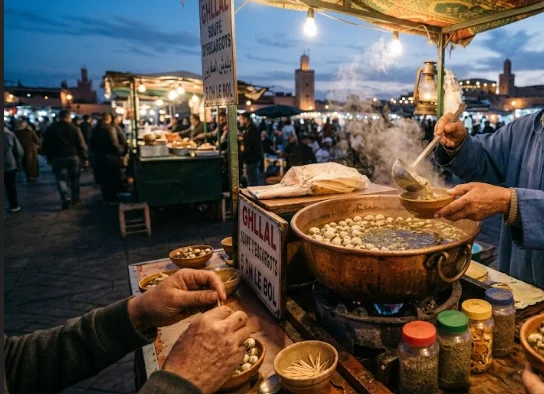
To understand this delicacy, you must look at its two components. The meal consists of tender land snails and an incredibly complex, peppery broth.
The secret to the dish lies entirely in that steaming liquid. Traditional Moroccan cooks use a delicate balance of over fifteen different herbs and spices.
Recipes vary slightly from one vendor to another. Each family claims to hold the ultimate secret recipe. However, the foundational ingredients usually include:
- Earthy herbs: Thyme, rosemary, and mint.
- Warm spices: Sweet aniseed, sharp caraway, and ginger.
- Bitter aromatics: Licorice root, gum arabic, and dried orange peel.
- Heat: A fiery kick of black pepper and dried red chilies.
The snails are cleaned meticulously. Next, they simmer in this aromatic brew for several hours. This lengthy cooking process ensures that the meat becomes incredibly tender. It also absorbs the profound, earthy flavors of the Maghreb. For many Moroccans, the intensely spiced liquid is prized even more than the meat itself.
The Medicinal and Restorative Properties
Eating snails in Marrakech is not merely about satisfying hunger. In Moroccan folklore, the herbal broth of Babbouche is a traditional remedy. Locals flock to the snail stalls on chilly winter evenings or when feeling sick.
The potent combination of ginger, chilies, and thyme acts as a natural decongestant. The broth warms the body from the inside out and aids digestion.
It is common to see residents bypass the snails entirely. Instead, they request a steaming cup of the spiced liquid to sip like tea. The heat from the pepper and ginger hits the back of your throat instantly. Then, a cooling sensation follows from the mint and aniseed. It remains a staple of local wellness culture.
How to Eat Snails in Marrakech Like a Local
If you are ready to take the plunge, follow the local etiquette. When you sit down at a cart, you do not need a menu. Simply hold up a finger to indicate you want a bowl.
The vendor will swiftly scoop a portion of shells from the bubbling cauldron. They top it off with dark broth and hand it to you. You will also receive a simple wooden toothpick or a safety pin.
The eating technique requires a bit of finesse:
- Take a shell between your thumb and index finger.
- Pierce the exposed meat with your toothpick.
- Gently pull with a slight twisting motion to slide the snail out.
- Pop it into your mouth and chew!
The texture is slightly chewy, akin to a dense mushroom or a clam. However, the flavor is an explosion of fifteen spices.
Once you empty every shell, the best part awaits. Lift the bowl to your lips and drink the remaining broth directly. It is earthy, spicy, and deeply comforting.
A Culinary Adventure Worth Taking
Travel is all about pushing boundaries and experiencing new cultures. Trying snails in Marrakech is an affordable, thrilling, and authentic way to do just that.
A standard bowl costs around 5 to 10 Moroccan Dirhams. This is less than $1 USD, making it a highly budget-friendly adventure.
The next time you wander through the chaos of the Medina, follow your nose to the steaming vats. Pull up a stool, embrace the unfamiliar, and let Babbouche warm your soul.
FAQ: Eating Snails in Marrakech
Are the snails in Marrakech safe to eat? Yes, they are very safe. The vendors in Jemaa el-Fnaa have a high turnover rate, so the food is always fresh. The snails are thoroughly washed multiple times with salt and vinegar before boiling for hours. This long process ensures they are completely clean.
What do Moroccan snails taste like? Unlike French escargot, this dish does not use garlic or butter. Instead, the snails taste entirely like the herbal broth. The meat itself is mild and mushroom-like in texture, while the flavor profile is dominated by aniseed, thyme, and ginger.
How much does a bowl of snails cost? It is one of the cheapest street foods in the city. A standard bowl typically costs between 5 to 10 Moroccan Dirhams. This is roughly equivalent to $0.50 to $1.00 USD.
Can I just drink the broth without eating the snails? Absolutely! Many locals do this when they have a cold. If you want to experience the flavor without the chewy texture, ask the vendor for a cup of broth alone.