
Berber Jewelry: Secrets to the Perfect Collection
- Home Décor & Traditional Crafts Moroccan Crafts
 Maroc Fans
- 0
- 17 minutes read

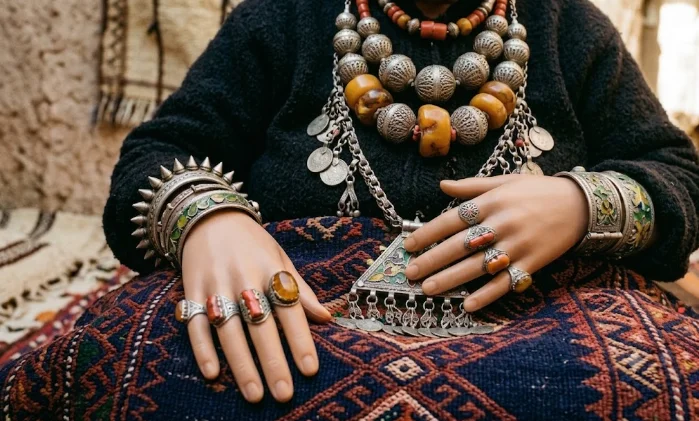
Beyond mere decoration, the heavy silver ornaments worn by Amazigh (Berber) women are an ancient language rendered in metal. Every engraving, enamel inlay, and cabochon stone tells a story. They reveal identity, protection, social status, and spiritual belief. For thousands of years across North Africa, authentic Berber jewelry served as a woman’s personal sanctuary. It remains a mobile archive of indigenous heritage.
To understand traditional Berber jewelry, step into a world where aesthetics and magic intertwine. Cold metal carries warm cosmic meaning. Every piece worn from crown to ankle serves a protective purpose.
The Sacred Metal: Why Berber Jewelry Is Silver, Not Gold
In traditional Amazigh culture, silver (aẓref) holds absolute supremacy over gold. Urban centers in North Africa historically favored gold under Mediterranean influences. However, rural Amazigh tribes revered silver as a sacred metal with heavenly connections.
According to ancient North African folklore, silver connects to the moon. It represents purity, coolness, and the feminine force of nature. By contrast, rural communities viewed gold with suspicion, associating it with vanity and greed. Silver Berber jewelry carried protective virtues (baraka). People believed it warded off the evil eye (ayn) and malicious spirits (jinn).
Silver also held practical value. For semi-nomadic tribes in the Atlas Mountains, silver Berber jewelry acted as portable wealth. A woman’s silver was entirely her own property. It served as a financial safety net for hard times.
Historical Roots: An Ancient Craftsmanship Tapestry
The style of Berber jewelry comes from centuries of cultural exchange across North Africa.
- Phoenician & Roman Influences: Early maritime trade introduced filigree and metalworking techniques. Mountain tribes quickly adopted these methods.
- The Role of Jewish Silversmiths: For centuries, Jewish artisans lived alongside Amazigh communities in southern Morocco. Master silversmiths in Tiznit and the Draa Valley blended Jewish techniques with Amazigh motifs.
- Andalusian Influx: In the late 15th century, exiled artisans arrived from Spain. They brought sophisticated enameling and filigree techniques to North Africa.
Iconic Types of Traditional Berber Jewelry
Amazigh women wore jewelry as part of their daily attire. A fully adorned woman wore heavy silver fibulas, layered necklaces, crown ornaments, and bold bangles.
1. The Fibula (Tazerzit or Tizerzai)
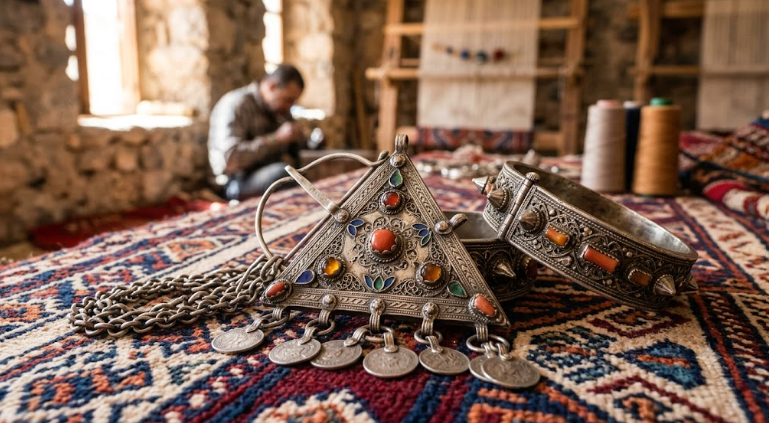
The fibula is the most symbolic piece of Berber jewelry. Functionally, it fastens heavy woven cloaks at the shoulders. The tazerzit consists of a triangular plate, a ring, and a central pin.
- Shape & Meaning: The triangular body represents female fertility and womanhood. The sharp pin points downward to ward off negative energy.
- Pairs & Chains: Women wore fibulas in symmetrical pairs on both shoulders. A heavy silver chain (tagemmout) decorated with coins and coral linked the two pins.
2. Necklaces (Tagemmout and Tazra)
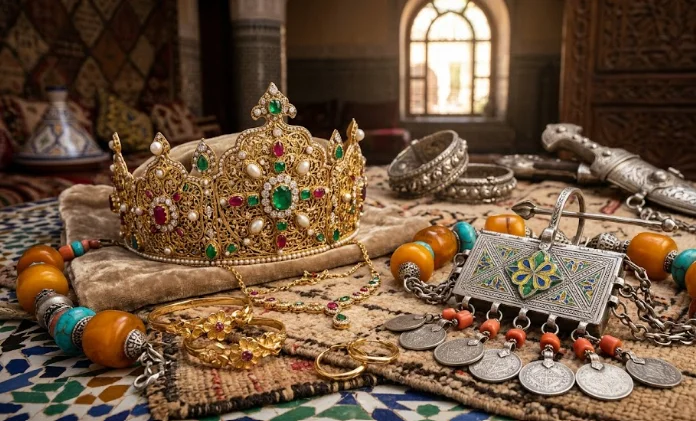
Berber necklaces are bold, striking pieces. Craftsmen made them from silver beads, natural amber, Mediterranean coral, enamel, and old coins.
- Tagemmout Beads: Massive silver spheres embellished with filigree, enamel, or small dangles.
- Coin Necklaces: Silversmiths used real Spanish, French, and Moroccan silver coins to display family wealth.
3. Headpieces and Crown-like Ornaments (Taj & Tazenar)
Headwear carries immense ceremonial importance during weddings. Silver crowns (taj) and forehead bands frame a woman’s face, protecting her vital spirit.
4. Heavy Bracelets (Nabliyat) and Anklets (Khlakhel)
Arm and leg ornaments were designed to be bold. Heavy silver bangles featured raised spikes or geometric engravings. Spiked bracelets (tanfous) offered both decoration and self-defense for traveling women. Anklets (khlakhel) created a rhythmic sound to drive away unseen spirits.
Decoding Symbols and Motifs in Berber Jewelry
Every motif in Berber jewelry is intentional. The visual style relies on cosmic and geometric imagery passed down through generations.
| Motif / Symbol | Visual Representation | Spiritual & Cultural Meaning |
| Triangle | Downward or upward triangle | Female fertility, protection against evil eye |
| Khamsa | Stylized 5-fingered hand | Defense, wards off jealousy and bad luck |
| Chevrons / Zigzags | Continuous mountain-like lines | Water, movement, vitality, life cycle |
| Spiral / Circle | Closed or open coils | Eternity, sun cycles, continuous rebirth |
| Rosette / Star | 6 or 8-pointed flowers | Celestial balance, harmony, cosmic connection |
| Lizard / Salamander | Stylized small reptile | Adaptability, protection, connection to earth |
The Power of Colors in Enamel and Stones
Color plays a vital role in Amazigh design:
- Red & Coral: Symbolizes blood, vitality, and life force.
- Yellow & Amber: Represents solar warmth, health, and abundance.
- Green: Represents nature, growth, and peace.
- Blue: Reflects the sky, water, and protective energy.
Regional Variations Across Morocco
Distinct regional styles emerged across North Africa based on geography and materials.
- The High Atlas: Jewelry here is bold, heavy, and minimal. Chiseled silver, geometric lines, and large amber beads dominate the region.
- The Anti-Atlas & Souss Valley: Tiznit is Morocco’s silver capital. Jewelers here perfected delicate filigree and colorful enamel in yellow, green, and blue.
- The Sahara & Draa Valley: Saharan styles reflect Tuareg influences. They feature geometric silver cutouts, leather accents, and the iconic Southern Cross (Cross of Agadez).
The Social & Economic Role of Berber Jewelry
In Amazigh culture, jewelry goes far beyond decoration. It marks social milestones and protects women’s independence.
- Financial Independence: Grooms presented brides with silver jewelry during marriage. This silver belonged exclusively to the woman. She could sell pieces in times of hardship to support her family.
- Tribal Identification: An observer could identify a woman’s tribe, status, and origin simply by looking at her silver motifs and enamel colors.
How to Identify Authentic Antique Berber Jewelry
Today, antique Berber jewelry faces competition from modern imitations made of cheap alloys. Look for these signs of authenticity:
- Weight & Feel: Real silver feels cool to the touch and has a solid weight. Cheap alloys feel light and warm up quickly.
- Patina & Wear: Antique pieces show gentle wear. Edges become smooth over decades of contact with skin and wool.
- Purity Stamp: Older pieces often contain tiny maker marks engraved by master silversmiths.
- Authentic Enamel & Stones: Antique pieces feature genuine red coral and amber. Plastic or acrylic substitutes indicate modern reproductions.
Frequently Asked Questions (FAQ)
1. What is the difference between Arab and Berber jewelry in Morocco?
Berber jewelry uses silver, geometric shapes, protective symbols, and enamel. Arab jewelry from urban centers like Fes or Marrakech relies mostly on gold, floral patterns, and precious gemstones.
2. Why is silver preferred over gold in Berber jewelry?
Silver is sacred in Amazigh tradition. People associate it with the moon, purity, and protective energy (baraka). It also served as portable wealth for rural communities.
3. What does the triangular Fibula (Tazerzit) symbolize?
The tazerzit symbolizes female fertility and protection. The triangle represents the womb, while the sharp pin shields the wearer from evil spirits.
4. Is modern Berber jewelry made of high-purity silver?
Master craftsmen still make 925 sterling silver pieces. However, many inexpensive market souvenirs use nickel, brass, or low-grade alloys. Always buy from reputable silversmiths.
5. What are the best places in Morocco to buy authentic Berber jewelry?
Tiznit is Morocco’s official silver capital. You can also find authentic pieces in Taroudant, Ouarzazate, Marrakech, and Essaouira.
6. What is the meaning of amber and coral in Berber jewelry?
Coral represents life force and vitality. Amber symbolizes health and solar energy. Both materials added deep spiritual value to traditional jewelry.
The Lasting Legacy of Amazigh Silver
Traditional Berber jewelry is a living symbol of North African pride, resilience, and spiritual depth. From the high peaks of the Atlas Mountains to the golden dunes of the Sahara, these silver treasures connect modern generations with an ancient heritage. They remain a brilliant testament to the skill and spirit of North Africa’s silversmiths.