
Morocco Currency Guide: How to Manage Money and ATMs
- Morocco Guide Travel Tips
 Maroc Fans
- 0
- 12 minutes read
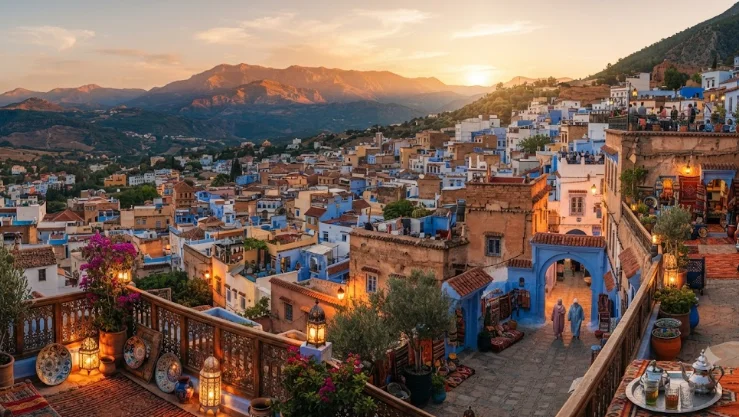
So, you are planning an unforgettable trip to Morocco! You are probably dreaming of wandering through the vibrant, spice-scented alleyways of Marrakech’s medina, watching the sunset over the Sahara dunes, or enjoying a fresh pot of mint tea in a coastal café. Before you pack your bags, however, there is one crucial practical step you cannot overlook: understanding Morocco currency mechanics. While Morocco is modernizing at lightning speed—with contactless payments and digital wallets spreading rapidly—it nevertheless remains a cash-heavy country. Navigating this mix of old-school cash transactions and new-school digital payments can certainly be tricky if you do not know what to expect.
This comprehensive guide covers everything you need to know about exchange rates, carrying cash, card payments, local tipping customs, and how to protect yourself from unnecessary banking fees using Morocco currency.
1. What Is the Official Morocco Currency?
The official Morocco currency is the Moroccan Dirham, abbreviated globally as MAD and locally represented by the symbol د.م..
Bank Al-Maghrib, the central bank, issues the Morocco currency, and it is divided into 100 centimes.
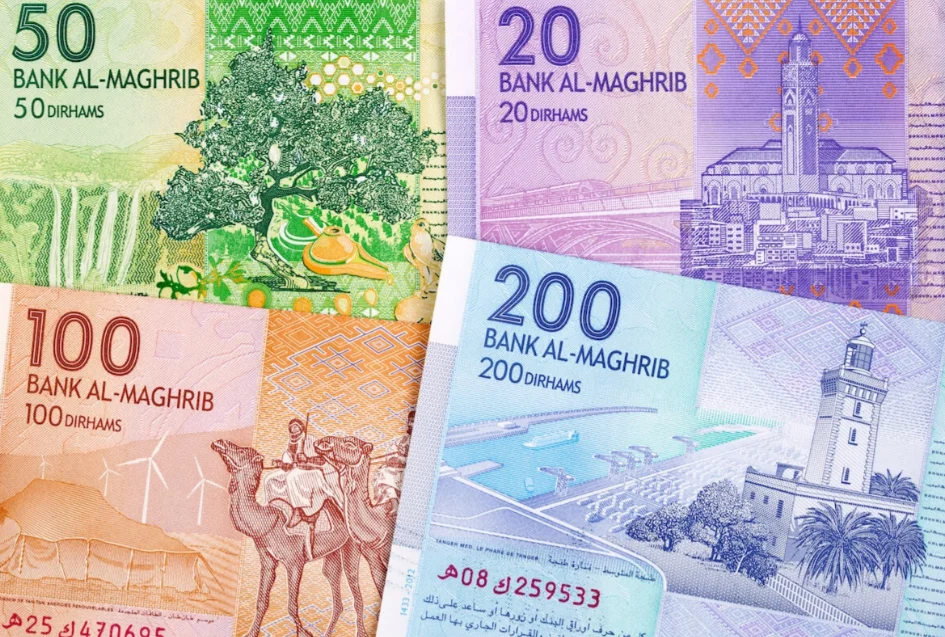
2. Banknotes and Coins in Circulation for Morocco Currency
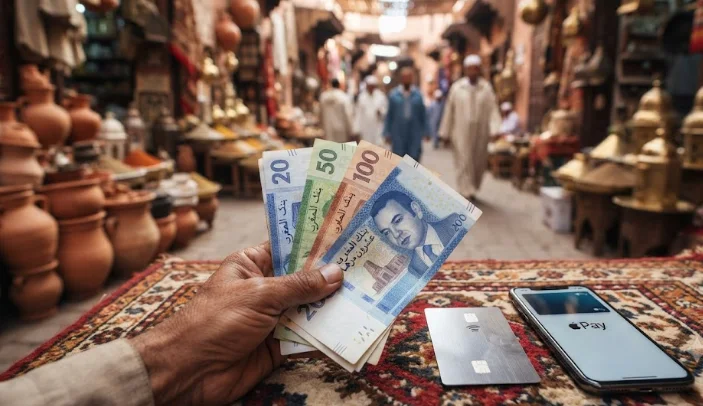
When dealing with physical cash of the Morocco currency, you will handle a mix of colorful polymer and paper banknotes as well as heavy metallic coins.
- Banknotes: Dirham notes come in denominations of 20 MAD, 50 MAD, 100 MAD, and 200 MAD. Each note features the portrait of King Mohammed VI alongside iconic historical sites, traditional architecture, or cultural landmarks.
- Coins: You will find coins in denominations of 1 MAD, 2 MAD, 5 MAD, and 10 MAD. Smaller bronze coins representing centimes (specifically 10, 20, and 50 centimes) also exist, although they are increasingly rare and primarily used for small change in local grocery stores.
Pro Tip: Try to break your larger bills (100 and 200 MAD) at supermarkets or hotels as soon as possible. Small taxi drivers, street food vendors, and local merchants in the souks will often struggle to make change for a 200 MAD note on a 15 MAD purchase!
3. Understanding Exchange Rates and Rules for Morocco Currency
One of the most important things to know about the Morocco currency is that it is a closed currency. Consequently, you cannot easily buy Moroccan Dirhams outside of Morocco, and it is legally restricted to import or export more than 2,000 MAD in cash.
Therefore, do not waste your time trying to get the Morocco currency from your local bank branch at home before your flight. You will need to obtain your cash once you land in the country.
4. Current Approximate Exchange Rates for Morocco Currency
To give you a rough sense of purchasing power, average exchange rates for the Morocco currency as of mid-2026 show that 1 USD is roughly equal to $9.35$ MAD.
Furthermore, 1 EUR is roughly equal to $10.64$ MAD, and 1 GBP is roughly equal to $12.50$ MAD. For quick mental math while shopping, many travelers round the exchange rate to 10 MAD per 1 EUR/USD to evaluate prices easily.
5. Cash vs. Card Payments Using Morocco Currency
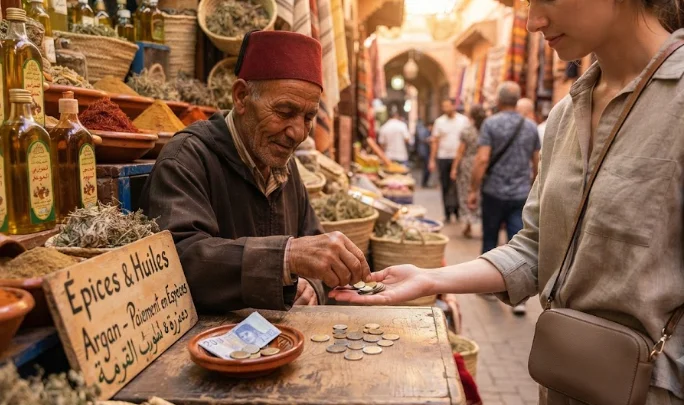
Morocco is a fascinating “hybrid” economy. If you stick purely to major cities like Casablanca, Rabat, or Marrakech, you might feel like you can get by with just your phone or card.
However, the moment you step into a traditional souk, hail a local taxi, or venture into smaller towns, physical Morocco currency is immediately required.
| Situation / Location | Recommended Payment Method | Why? |
| Luxury Riads & Hotels | Credit/Debit Card | Standard and secure for high-value bookings. |
| Supermarkets | Credit/Debit Card / Apple Pay | Seamless contactless terminals are widely available. |
| Taxis | Cash Only (Coins & Small Bills) | Drivers do not have card machines; exact change is appreciated. |
| Traditional Souks | Cash Only | Over 95% of artisans accept physical money only. |
| Tipping Staff | Cash Only | Gratitude is always handled with physical bills. |
6. The Rise of Digital Payments in Morocco
It is worth noting that Moroccan digital payments have leaped forward alongside traditional Morocco currency usage. Apple Pay has officially launched in Morocco, meaning iPhone and Apple Watch users can use it at modern establishments supported by major national banks.
Maroc Pay also serves as the national QR code payment standard developed to promote financial inclusion. Furthermore, Bank Al-Maghrib capped interchange fees for small retailers at 0.15% in mid-2026 to encourage more local vendors to accept digital payments. Despite these exciting digital developments, we still highly advise carrying cash at all times.
7. How to Get Moroccan Dirhams Without Losing Money
Since you cannot easily acquire Dirhams before your trip, you will need to get them upon arrival. There are two primary ways to do this: exchanging physical foreign cash or withdrawing from an ATM.
If you prefer to carry physical currency to exchange, bring Euros, US Dollars, or British Pounds. Avoid airport exchange booths because their rates are notoriously bad. Once you get into the city, look for independent exchange bureaus instead, as they offer much better rates and do not charge commission.
Using an ATM is generally the easiest way to get local currency. Stick to machines attached to major local banks, always decline Dynamic Currency Conversion by choosing MAD, and watch out for local ATM operator fees.
8. Tipping and Bargaining Etiquette with Morocco Currency
Understanding the Morocco currency is only half the battle; you also need to know how to use it socially. Tipping is an integral part of the economic structure, especially in the service industry where many workers rely heavily on tips to make a living wage.
- Cafés & Casual Diners: Leave 2 to 5 MAD on the table.
- Fine Dining Restaurants: A tip of 10% of the total bill is standard.
- Hotel Porters: Hand over 10 to 20 MAD for carrying your bags.
- Tour Guides / Drivers: Budget 100 to 200 MAD per day for private guides.
Bargaining is likewise a cultural sport in Morocco, particularly in the medinas. When you find a leather bag, lamp, or rug you love, remember that the initial price quoted is almost always inflated. Never negotiate if you have no intention of buying, as it is considered impolite.
Frequently Asked Questions
Can I use Euros or US Dollars directly in Morocco?
In some touristy areas, merchants and private tour operators may accept foreign currencies. However, they will often round the exchange rate heavily in their own favor. It is always much cheaper and safer to pay in the local Morocco currency.
How much cash should I carry daily?
For an average day of exploring, dining, and taking taxis, carrying 300 to 500 MAD per person in small denominations of Morocco currency is usually more than enough.