

What is Couscous? You Need to Know About This Famous Dish
- Moroccan cuisine Morocco Guide
 Maroc Fans
- 0
- 12 minutes read


When traveling through the vibrant souks of Marrakech or exploring the historic alleys of Fes, there is one rich, aWhen traveling through the vibrant souks of Marrakech, a rich scent binds the country together. This is the aroma of fresh steaming couscous. But for those discovering North African cuisine, a fundamental question often arises. What is couscous, where does it come from, and how did it become the ultimate culinary symbol of Morocco?
Far more than just a simple side dish, traditional Moroccan couscous represents family, history, and community. In this ultimate guide, we will dive deep into its origins, cultural significance, and preparation methods. Consequently, you will understand exactly why it captures the hearts of food lovers worldwide.
What is Couscous and Where Does it Come From?
To truly answer what is couscous, we have to travel back centuries into North African history. Couscous is the ancestral staple food of the Maghreb region. Specifically, it was created by the indigenous Berber (Amazigh) people. Archaeological evidence suggests that primitive couscous steamers were used by Berbers as early as the 3rd century BC.
The word itself is derived from the Berber word Seksu, which means well-rolled or rounded. Over the centuries, this incredible dish spread throughout North Africa. Eventually, it reached Europe, the Middle East, and the Americas. Today, its cultural value is immense. As a result, the global heritage organization UNESCO officially inscribed North African couscous onto its Intangible Cultural Heritage list.
Is Couscous a Grain or a Pasta?
One of the most common misconceptions people have when asking what is couscous is trying to classify it as a type of raw grain. For instance, many compare it to rice or quinoa.
In reality, couscous is technically a form of pasta! It is made from semolina, which is coarse flour ground from durum wheat. To create traditional couscous, the semolina is lightly sprayed with salted water. Then, it is rubbed between the palms of the hands to form tiny pellets. These pellets are dusted with dry flour to keep them separate and sieved to ensure a uniform size.
However, there is a big difference between commercial and authentic versions. You can easily buy modern “instant couscous” in Western supermarkets. This version only requires a quick soak in boiling water. In contrast, authentic Moroccan couscous undergoes a beautiful, slow steaming process. This method gives it an incredibly light, fluffy, and cloud-like texture.
The Friday Tradition: Why Do Moroccans Eat Couscous on Fridays?
You cannot fully understand what is couscous without experiencing a typical Friday in Morocco. In Moroccan culture, Friday is the holy day of the week. Therefore, it is equivalent to Sunday in Western cultures.
After the communal Friday midday prayers (Jumu’ah), shops temporarily close and streets quiet down. Then, families gather around a massive, single ceramic dish for the traditional Friday lunch. Eating couscous on this day is a sacred ritual of togetherness.
A Symbol of Solidarity: What is Couscous to Moroccan Culture?
Traditionally, couscous is a dish made for sharing. It is meant to be eaten with a large group of family members, neighbors, and even unexpected guests. In fact, it is a widespread custom for families to prepare extra portions of Moroccan couscous. They distribute these meals to the local mosque, the poor, or passersby. Ultimately, eating from a single shared platter signifies equality, harmony, and blessing (Baraka).
How is Authentic Moroccan Couscous Made?
The true magic of an authentic Moroccan couscous lies in how it is cooked. To achieve this, a specialized double-chambered pot called a Couscoussier (or Kiskaas in Arabic) is required.
- The Lower Pot: A rich, deeply seasoned broth simmered with meat (beef, lamb, or chicken), onions, and chickpeas. It also includes a fragrant blend of Moroccan spices like ginger, turmeric, saffron, and black pepper.
- The Upper Steamer: The damp semolina grains are placed in the perforated upper basket. As the broth boils below, its aromatic steam rises through the holes. Consequently, it gently cooks the couscous grains above.
Furthermore, this steaming process is repeated two to three times. Between each steaming session, the cook removes the couscous and dumps it into a wide wooden basin. They break up any lumps with their hands. Finally, they rub it with water, olive oil, or traditional aged butter known as Smen to give it a distinct savory depth.
Beyond the Recipe: What is Couscous aux Sept Légumes?
If you look at a traditional plate of Moroccan couscous, you will notice a magnificent pyramid of colorful vegetables. These ingredients completely blanket the fluffy semolina. The most famous variation is known as Couscous aux Sept Légumes (Seven Vegetable Couscous).
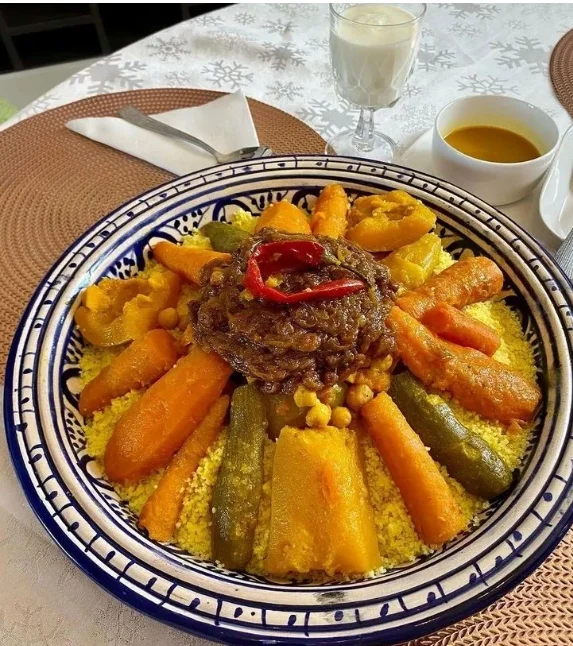
The number seven is considered auspicious in Islamic culture. For example, the classic combination typically includes:
- Sweet Carrots
- Tender Zucchini
- Pumpkin or Butternut Squash
- Turnips
- Cabbage
- Sweet Potatoes
- Chickpeas
On the other hand, for those who love a sweet-and-savory contrast, Moroccans also make a spectacular version called Tfaya. This variation tops the savory meat and couscous with a thick mountain of caramelized sweet onions, raisins, and cinnamon. This combination creates a truly unforgettable flavor profile.
How to Eat Couscous Like a Local
If you ever find yourself invited to a Moroccan home to enjoy this national dish, there are a few cultural etiquette rules to keep in mind:
- Use Your Right Hand: Traditionally, older generations do not use spoons. Instead, they masterfully roll a small amount of couscous, vegetables, and meat into a perfect ball. They use only the fingers of their right hand, then flick it into their mouth. However, if you are a beginner, don’t worry. Most modern households will happily hand you a spoon!
- Stay in Your Section: The large round platter is divided into imaginary “pizza slices.” You should always eat from the section directly in front of you. From there, slowly work your way toward the center where the tender meat is placed.
- The Lben Pairing: To complete the authentic experience, wash your meal down with a cold glass of Lben (traditional fermented buttermilk). Its tart coolness cuts through the rich spices of the warm broth perfectly.
Conclusion: What is Couscous if Not a Culinary Story?
Ultimately, when someone asks what is couscous, the answer isn’t just about semolina and vegetables. It is a story of North African resilience. It represents centuries of craftsmanship passed down from grandmothers to daughters. Moreover, it showcases an open-door policy of hospitality that defines Moroccan culture.
Whether you cook it at home using an authentic recipe or order it fresh at a local riad, eating traditional Moroccan couscous is a unique experience. In short, it is a meal that nourishes both the body and the soul.