

Zellige Tiles of Fes: Secrets to the Perfect Home
- Moroccan Crafts Pottery & Zellige
 Maroc Fans
- 0
- 24 minutes read

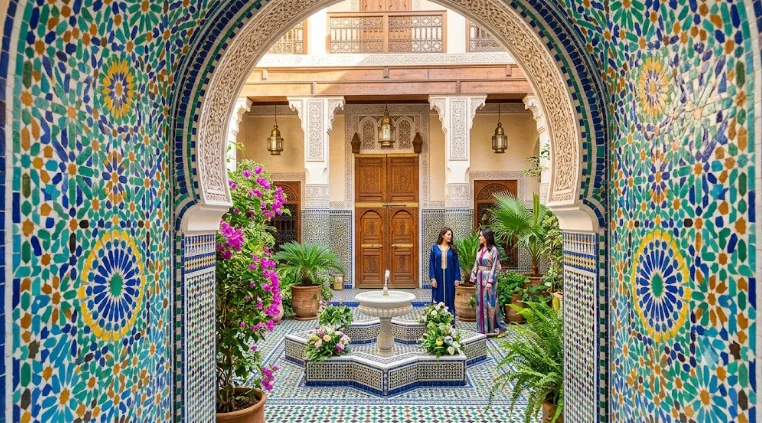
For over a millennium, Moroccan architecture has showcased the beauty of handmade ceramic mosaics. Vibrant colors and striking geometry define these classic installations. Among all artisan cities across North Africa, Fez remains the historic heart of this ancient craft. Authentic Zellige tiles from Fez are not simple decorative elements. Instead, they represent a living heritage that bridges Islamic geometry and human skill.
Every individual tile piece found in a Moroccan palace is shaped entirely by hand. Artisans fire the local clay using organic fuels. Next, they glaze the pieces with natural minerals and chisel every edge with high precision. Understanding this traditional craft requires exploring the unique gray clay of Morocco. It also means appreciating how master craftsmen (Maâlems) transform humble earth into architectural art.
History and Andalusian Roots of Zellige Tiles
The story of Moroccan tilework ties directly to the artistic evolution of the Maghreb. While glazed mosaics existed in ancient Rome and Byzantium, Moroccan tilework developed its own identity under Islamic rule. Artisans focused on rich geometric patterns and abstract art.
Andalusian Influences on Zellige Tiles
Early forms of glazed ceramics appeared in North Africa during the 10th century. However, the true golden age of mosaic art arrived after the fall of Islamic Spain. Artisans migrated from Cordoba, Granada, and Seville to Morocco. They brought refined glazing techniques and intricate geometric concepts.
Fez became the ideal center for these migrating craftspeople. The city offered vast reserves of gray clay and fresh river water. Olive orchards provided fuel for kilns, while the royal court funded monumental buildings. To learn more about these heritage techniques, explore our guide on authentic Moroccan artisanal heritage.
The Marinid Era and Authentic Zellige Tiles
During the Marinid Dynasty (13th to 15th centuries), mosaic art achieved its iconic form. Marinid sultans built famous madrasas, mosques, and palaces across Morocco. Key examples include the Bou Inania Madrasa and the Al-Attarine Madrasa in Fez.
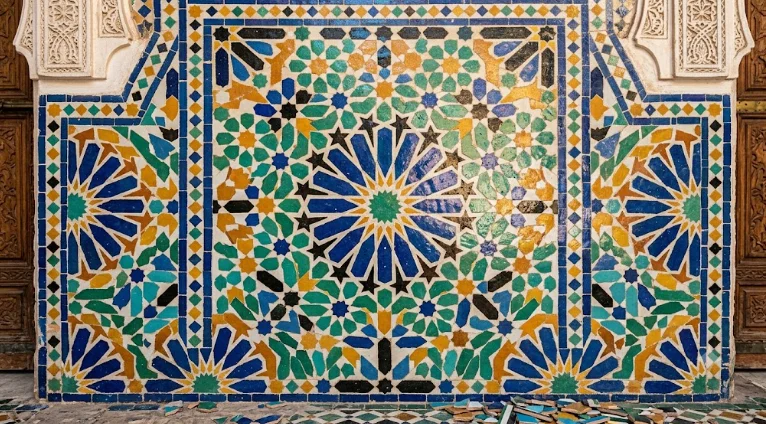
Artisans shifted from basic monochrome tiles to multi-colored geometric mosaics. These complex designs featured dozens of individually hand-cut shapes (furmah). Furthermore, the color palette expanded to include cobalt blue, emerald green, honey yellow, and black. For historic documentation on North African tiles, visit the Victoria and Albert Museum Islamic Art Collection.
Why Fez Earth Forms the Best Zellige Tiles
Not all Moroccan tilework features the same quality. Tile workshops exist in Marrakech, Meknes, and Tetouan. However, architects and purists prefer Zellige tiles made in Fez. The secret lies in the natural clay beds of Ben Jellik.
Ben Jellik Clay Properties for Zellige Tiles
The gray clay surrounding Fez possesses exceptional chemical properties:
- Purity and Plasticity: The fine clay contains no lime. It becomes very smooth when mixed with water, which prevents cracking.
- Thermal Resilience: It resists extreme kiln heat without warping or breaking.
- Ideal Density for Cutting: The fired raw tile (bejmat) reaches a precise structural density. As a result, craftsmen can strike it with heavy tools without shattering the glaze.
Producing traditional mosaics with standard factory clay yields poor results. Non-native clay often leads to chipped glazes, uneven firing, or weak mosaic pieces.
Raw Preparation for Handmade Zellige Tiles
The creation of authentic Zellige tiles remains entirely manual. Modern machinery cannot match the subtle surface shifts and organic charm of hand-cut tiles. The journey from raw earth to finished panel involves seven clear steps.
Extracting and Washing the Raw Clay
Workers mine gray clay from the hills of Fez and transport it to Ain Nokbi. They submerge the material in large outdoor water basins for several days. Next, artisans stomp through the wet mixture to crush hard lumps and remove small stones by hand.
Molding and Sun-Drying the Tiles
Artisans knead the smooth clay dough to remove internal air bubbles. This step prevents small explosions inside the hot kiln. Craftsmen press the clay into wooden molds to create flat tiles measuring roughly $10 \times 10\text{ cm}$. Afterward, these raw pieces dry naturally under the warm sun for several days.
Kiln Firing and Mineral Glazing of Zellige Tiles
Once the clay loses all moisture under the sun, it enters a two-stage firing process with hand glazing in between.
The Initial Kiln Firing (Laqch)
Unbaked clay squares are packed carefully into subterranean brick kilns. The pieces undergo an initial firing at temperatures between $800^\circ\text{C}$ and $900^\circ\text{C}$. Historically, artisans fueled these traditional kilns with dried olive pits, which deliver steady heat.
Applying Natural Mineral Glazes to Zellige Tiles
After cooling down, artisans dip each tile into natural liquid glaze. Vibrant colors come directly from raw mineral compounds:
- Blue: Cobalt oxide
- Green: Copper oxide
- Yellow: Iron oxide
- White: Tin oxide
- Brown and Black: Manganese dioxide
Artisans mix these glazes by eye and apply them manually. Because of this process, no two tiles share the exact same shade. This subtle color variation gives the finished installation a shimmering finish.
The Second Glaze Firing Phase
Glazed pieces return to the heat for a second firing. Heat inside traditional kilns is naturally unequal. Tiles placed near the fire chamber receive maximum heat, while top tiles receive less. This variable environment creates rich glaze variations and tiny surface pinholes.
Hand-Chiseling and Assembly of Zellige Tiles
Transforming square tiles into intricate geometric panels requires high spatial memory and sharp physical control.
Chiseling Geometric Edges (Nqach)
This delicate step sets real artisan tilework apart from standard factory options. Glazed squares pass to specialized cutters called Nqachin. Using a brush, the cutter draws geometric shapes onto the glazed face.
The artisan holds a heavy double-pointed iron hammer (manqar). They strike the tile edge at a sharp $45^\circ$ angle. This cut creates a beveled edge beneath the tile. As a result, neighboring pieces sit flush against each other on top.
   [ Glazed Top Surface ]
    ____________________
   /                    \   <-- 45-degree hand-chiseled bevel (Manqar cut)
  /                      \
 /________________________\
    [ Raw Clay Base ]
Assembling Mosaic Panels in Reverse
The final fitting process relies on memory and touch. The master craftsman places individual shapes face-down on a flat floor. Because the smooth glaze rests against the ground, the artisan works in reverse. They judge every piece by shape and rough back texture.
Once thousands of small pieces fit together tightly, workers pour liquid mortar or resin over the back. This step locks the mosaic into stable panels. Flipping the panel reveals the seamless geometric pattern.
Sacred Geometry Principles in Zellige Tiles
Mosaic design rests on sacred Islamic geometry. Repeating patterns express concepts of unity, balance, and infinity. Creating these layouts requires precise math calculations without software.
Common Patterns in Zellige Tiles
- Star Polygons (Rozac): Central stars with 8, 12, 16, or 24 points anchor complex designs.
- Interlocking Bands (Khott): Woven geometric lines symbolize the infinite nature of creation.
- Named Tesserae Shapes: Individual cut shapes carry classic names like N’chma (star), Safina (boat), and M’qas (scissors).
Master craftsmen (Maâlems) memorize hundreds of complex geometric formulas called the Hasba. This mental system ensures every shape fits across large walls. To review historical protection guidelines for these surfaces, visit the UNESCO World Heritage Centre guide on Historic Fez.
Comparing Artisan Zellige Tiles with Factory Ceramics
Distinguishing authentic hand-chiseled Zellige tiles from factory-made ceramic substitutes is essential when planning a renovation project.
| Feature / Characteristic | Authentic Hand-Chiselled Zellige Tiles | Machine-Made “Zellige Style” Ceramics |
| Origin of Clay | 100% Natural Ben Jellik Gray Clay (Fez, Morocco) | Industrial white or red ceramic clay |
| Production Method | Hand-molded, sun-dried, hand-glazed, olive fired | Industrial press, automated roller kilns |
| Edge Finish | $45^\circ$ hand-chiseled bevels (Manqar cut) | Straight, factory-rectified, or rounded edges |
| Surface Texture | Irregular, organic pinholes, hand-dipped depth | Uniformly flat or artificially stamped texture |
| Color Shading | High chromatic variation ($V4$), natural minerals | Flat, uniform color batching ($V1$ or $V2$) |
| Grout Line Width | Ultra-tight joints ($1\text{ to }2\text{ mm}$ butt-jointed) | Standard wide grout lines ($3\text{ to }5\text{ mm}$ required) |
| Lifespan & Value | Decades to centuries; grows richer with age | Standard ceramic life; vulnerable to short trends |
| Craft Value | Direct support for Moroccan artisan families | Mass industrial factory production |
Modern Home Uses for Zellige Tiles
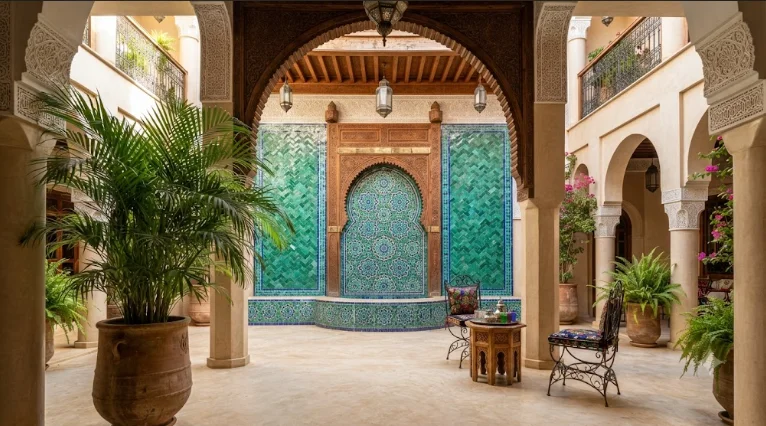
Historically, these mosaics decorated public fountains, palaces, and madrasas. Today, interior designers worldwide incorporate authentic Zellige tiles into modern homes and hotels.
Bathrooms and Wet Rooms
Glazed tile surfaces repel water naturally. This quality makes them ideal for shower walls, vanity backsplashes, and tub surrounds. Soft light bounces off uneven tile surfaces to create a soothing spa atmosphere.
Kitchen Backsplashes and Islands
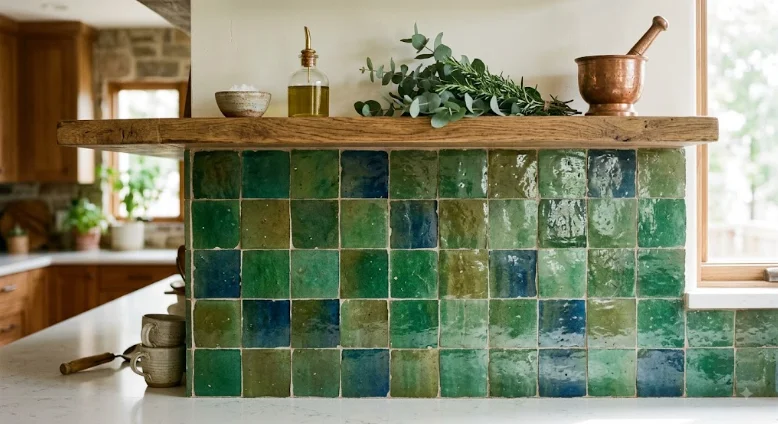
Handcrafted Zellige tiles bring warmth to modern kitchen interiors. Glossy tile surfaces create dynamic contrast alongside sleek cabinets, marble counters, and natural wood accents.
Feature Walls and Fireplace Surrounds
A floor-to-ceiling accent wall functions as a permanent art piece. Reflective clay tiles turn living room fireplaces and patio fountains into dramatic features.
Installation Steps for Zellige Tiles
Installing handmade clay tiles requires specific techniques to ensure durability and strong visual results.
Substrate and Adhesive Preparation
Make sure all wall or floor surfaces are completely flat, clean, and dry before starting work. Select a flexible tile adhesive formulated for low-absorption clay tiles.
Mixing Boxes for Color Balance
Always open and mix tiles from several different boxes before starting installation. Because natural glazes produce subtle shade variations, mixing tiles ensures an even color spread across your wall.
Setting Tight Grout Joints
Hand-cut tiles require very narrow grout lines. Apply a fluid, non-sanded grout that flows smoothly into the tight gaps created by beveled tile edges.
Cleaning and Care for Zellige Tiles
Proper maintenance keeps hand-finished ceramic surfaces clean without harming delicate mineral glazes.
Simple Everyday Cleaning
Glazed surfaces need simple routine care. Wash tiles using warm water and a neutral pH liquid soap. Avoid aggressive chemical cleaners or acidic solutions, which can dull glazes and erode grout over time.
Sealing Unglazed Floor Tiles
If you choose unglazed terracotta tiles (Bejmat) for floors, apply a breathable penetrating sealer. This step protects porous raw clay from oil and liquid stains while preserving its natural warm tone.
Frequently Asked Questions About Zellige Tiles
What is the main difference between Zellige tiles and Bejmat?
Zellige tiles refer to thin, glazed clay tiles chiseled into geometric shapes for decorative walls and fountains. In contrast, Bejmat refers to thicker, unglazed rectangular clay bricks used for high-traffic floors, courtyards, and outdoor patios.
Why do Zellige tiles show surface variations and tiny imperfections?
Imperfections like surface pinholes, color variations, and slight edge curves are natural traits of real Zellige tiles. They result directly from hand molding, mineral glazes, and variable kiln heat. These organic traits reflect light dynamically and distinguish real handcraft from factory tiles.
Can Zellige tiles withstand freezing outdoor weather?
Glazed clay tiles perform well outdoors in mild or Mediterranean climates. However, in regions with severe freeze-thaw cycles, raw clay can absorb moisture through tiny surface pinholes. This absorbed water may cause glaze damage during hard freezes. For cold regions, install tiles in sheltered outdoor zones or apply high-grade penetrating sealers.
Are authentic Moroccan Zellige tiles expensive?
Handmade Moroccan tilework is a premium artisan product. Higher costs reflect the intensive manual labor required at every stage—from mining Ben Jellik clay to hand-chiseling thousands of individual pieces. Purchasing real tiles supports traditional craft families and yields a durable finish that lasts for decades.
How do I know if Zellige tiles are truly handmade in Morocco?
Real Moroccan Zellige tiles feature a pale-gray to buff clay body beneath the glaze, characteristic of Fez earth. The back of each tile shows manual hand-pressed marks instead of machine grid lines. Furthermore, tile edges show sharp $45^\circ$ hand-chiseled bevels rather than uniform factory cuts.
The Lasting Legacy of Moroccan Craftsmen
The story of Moroccan tilework rests on human dedication. In an age dominated by fast factory manufacturing, Moroccan master craftsmen (Maâlems) preserve an ancient art. Their process requires patience, mathematical discipline, and respect for natural earth. Every chiseled edge and glazed face carries centuries of tradition, turning everyday walls into living galleries.
For a deeper look into these iconic handcrafted ceramics, check out our detailed overview on What is Moroccan Zellige? Everything You Need to Know.