
Traditional Moroccan Jewelry: Secrets to the Best Gems
- Home Décor & Traditional Crafts Moroccan Crafts
 Maroc Fans
- 0
- 20 minutes read

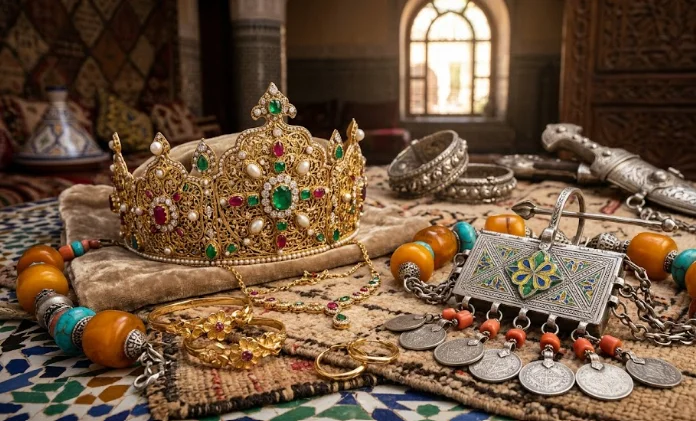
Moroccan craftsmanship is celebrated worldwide for its vibrant colors and intricate patterns. Among these crafts, traditional Moroccan jewelry stands out as a living testament to centuries of cultural fusion and artistic mastery.
From the High Atlas Mountains to the royal palaces of Marrakech, jewelry has always been far more than mere decoration. Indeed, traditional Moroccan jewelry serves as a visual language. It communicates identity, marital status, and spiritual protection. Whether crafted from silver or gold, every piece carries a rich story.
In this guide, we explore the history, regional styles, and sacred symbols behind authentic traditional Moroccan jewelry.
The History and Heritage of Traditional Moroccan Jewelry
The story of traditional Moroccan jewelry is an intricate tapestry. It combines Amazigh, Arab, Andalusian, and Jewish traditions.
                  +-----------------------------------+
                  |   Amazigh (Berber) Roots          |
                  |   Rural, Silver, Protective       |
                  +-----------------+-----------------+
                                    |
                                    v
+-----------------------------------+-----------------------------------+
| Andalusian-Jewish Silversmiths    | Arab-Islamic Palace Traditions    |
| Intricate Filigree & Enameling    | Refined Gold & Precious Stones    |
+-----------------+-----------------+-----------------+-----------------+
                  |                                   |
                  +-----------------+-----------------+
                                    |
                                    v
                  +-----------------------------------+
                  | Traditional Moroccan Jewelry      |
                  | Living Heritage & Modern Artistry |
                  +----------------+------------------+
The Amazigh Legacy in Traditional Moroccan Jewelry
The Amazigh people have inhabited North Africa for thousands of years. For rural Amazigh communities, silver was the primary metal. Unlike gold, silver is associated with purity, moonlight, and protection against the evil eye (عين).
Historically, Amazigh women wore heavy silver ornaments every day. Furthermore, these items acted as a personal savings account. Therefore, jewelry provided vital financial independence for women during difficult times.
Andalusian and Jewish Influences on Traditional Moroccan Jewelry
During the late 15th century, many Sephardic Jews and Muslims fled Spain. Consequently, thousands settled in Moroccan cities like Fez and Essaouira. Jewish silversmiths introduced advanced techniques such as fine filigree and enamel work.
For centuries, Jewish silversmiths (mâallems) crafted exquisite ornaments. However, they worked closely with Muslim artisans. Together, they created the unique style of traditional Moroccan jewelry we admire today.
Urban vs. Rural Traditional Moroccan Jewelry Styles
To understand traditional Moroccan jewelry, one must distinguish between rural and urban styles.
| Feature | Rural (Amazigh) Jewelry | Urban (Citadin) Jewelry |
| Primary Metal | Silver | Gold (or gilded silver) |
| Origin Regions | Atlas Mountains, Souss, Sahara | Fez, Marrakech, Rabat, Tetouan |
| Techniques | Engraving, Enamel, Coral Inlay | Filigree, Stone Setting, Granulation |
| Function | Protection, Identity, Savings | Luxury, Prestige, Elegance |
| Key Pieces | Fibula, Heavy Bracelets, Khamsa | Tiara, Headband, Lebba Necklace |
1. Rural Amazigh Silver Jewelry
Rural jewelry is bold, heavy, and deeply symbolic. Crafted mainly in silver, these pieces feature strong geometric forms. Additionally, artisans add natural materials like Mediterranean red coral and amber beads.
In addition, techniques like colorful enamel and dark etching are common. As a result, these styles thrive in the Souss region and the town of Tiznit.
2. Urban Gold Jewelry
In contrast, urban jewelry flourished in historic imperial cities. Influenced by Andalusian luxury, urban craftsmen prioritized gold, pearls, emeralds, and rubies.
For instance, artisans in Fez specialized in filigree work. This method requires twisting thin gold wires into lace-like patterns. Ultimately, urban traditional Moroccan jewelry was designed to complement grand silk caftans.
Iconic Types of Traditional Moroccan Jewelry
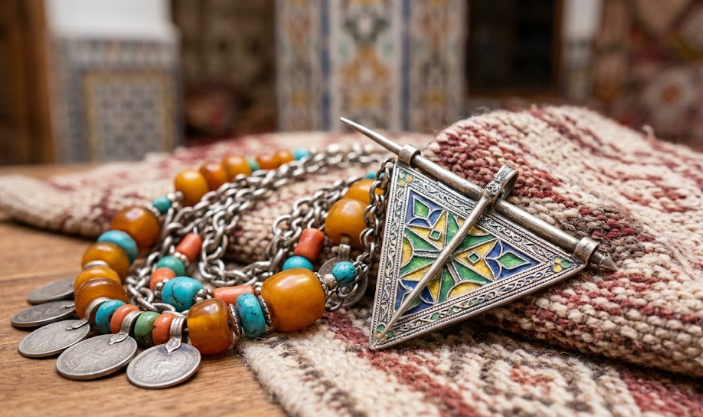
Traditional Moroccan jewelry encompasses a wide variety of ornaments. Below are the most famous pieces.
       [ Taj / Crown ]
              |
   [ Khiti Rhabat (Headband) ]
              |
      [ Berber Earrings ]
              |
  [ Lebba / Cherka (Necklace) ]
              |
    [ Fibula (Tizra/Tissegnit) ]
              |
    [ Nekkache (Bracelets) ]
              |
   [ Khalkhal (Anklets) ]
The Fibula (Tizra or Tissegnit)
The fibula is a famous symbol of Amazigh heritage. It is a large triangular brooch made of silver. Originally, women used the fibula as a practical clasp for heavy wool cloaks.
Often connected by silver chains or amber beads, fibulae feature detailed engravings. Meanwhile, the triangular shape represents fertility, womanhood, and protection.
The Khamsa (Hand of Fatima)
The Khamsa is an ancient protective amulet shaped like an open palm. In Morocco, artisans craft the Khamsa in delicate gold filigree as well as carved silver.
Whether worn as a pendant or on a necklace, the Khamsa wards off negative energy. Thus, it brings luck and spiritual blessings (baraka) to the wearer.
The Lebba (Urban Ceremonial Necklace)
The Lebba is a grand urban necklace originating from Fez. It features multiple tiers of gold plates, pearls, emeralds, and rubies. Typically worn by brides, the Lebba drapes dramatically across the chest.
Nekkache and Serrar (Silver Bracelets)
Amazigh women frequently wear pairs of heavy silver cuffs. These bracelets come in distinct designs:
- Nekkache: Beautifully engraved silver cuffs with floral or geometric patterns.
- Serrar (Spiked Bracelets): Heavy cuffs with raised studs. Historically, women used these spiked bracelets for self-defense while traveling.
The Khalkhal (Traditional Anklets)
The Khalkhal is a heavy silver or brass anklet worn in rural regions. Frequently, it contains small loose pebbles inside. Consequently, these pebbles create a soft chiming sound when the wearer walks.
Symbols and Motifs in Traditional Moroccan Jewelry
Every shape and stone in traditional Moroccan jewelry carries a specific protective meaning.
- Triangles: Represent fertility, womanhood, and home protection.
- Chevrons and Zigzags: Symbolize water and life streams.
- Red Coral: Believed to promote vitality and absorb bad energy.
- Amber: Associated with warmth, health, and positive energy.
- Enamel Colors: Yellow means sun and abundance. Green represents nature and peace. Blue symbolizes divine protection.
Centers of Traditional Moroccan Jewelry
If you want to buy authentic pieces, several Moroccan towns are famous for their craftsmanship.
| City / Region | Specialty & Renowned Styles |
| Tiznit | Amazigh silver, enamel, and fibulae |
| Essaouira | Silver filigree and stone work |
| Fez | Imperial gold jewelry and Lebba necklaces |
| Taroudant | Antique Berber silver and heavy cuffs |
| Guelmim | Sahrawi silver and minimalist designs |
Tiznit: The Silver Capital
Located near the Anti-Atlas Mountains, Tiznit is known as the silver capital. The town’s market houses hundreds of silversmith shops. Here, master craftsmen create some of the finest traditional Moroccan jewelry available.
Essaouira: Master Filigree
The coastal city of Essaouira has a rich Jewish silversmith heritage. Today, local artisans produce fine silver filigree with turquoise and coral accents.
Fez: Imperial Gold
As the cultural heart of Morocco, Fez is famous for gold craftsmanship. In the historic Medina, goldsmiths create elaborate bridal sets and engraved bangles.
How to Identify Authentic Traditional Moroccan Jewelry
Markets are sometimes flooded with modern factory imitations. Therefore, keep these simple tips in mind:
- Check Metal Stamps: Genuine silver carries official hallmark stamps indicating purity (800 to 925 sterling silver).
- Examine the Weight: Authentic silver pieces feel noticeably heavy. Conversely, cheap imitations feel light and flimsy.
- Inspect Craftsmanship: Handcrafted items show minor variations. However, perfectly identical patterns suggest factory production.
- Test the Temperature: Real silver and natural stones feel cold at first. On the other hand, plastic imitations warm up quickly.
- Look for Natural Amber: Real amber contains slight imperfections. In contrast, synthetic amber is lightweight and completely clear.
For more information on local crafts, read our guide on The Secrets of Moroccan Leather Craftsmanship.
How to Care for Traditional Moroccan Jewelry
To keep your silver bright and beautiful, follow these simple maintenance steps:
- Storage: Keep silver items in a dry place wrapped in soft cloth.
- Cleaning: Clean gently with a soft polishing cloth. Avoid harsh chemicals, because they can damage colored enamel.
- Avoid Chemicals: Remove jewelry before swimming or using cleaning products.
You can also pair your jewelry with classic attire. Learn more in our article about The History and Evolution of the Moroccan Caftan.
Frequently Asked Questions
1. What is the difference between rural and urban traditional Moroccan jewelry?
Rural jewelry is made of silver with bold geometric patterns and enamel. In contrast, urban jewelry uses gold, fine filigree, and precious gemstones.
2. Is traditional Moroccan jewelry made of real silver?
Yes, authentic rural jewelry uses high-grade silver (800 to 925 purity). Always look for hallmark stamps to confirm metal quality.
3. What does the triangular fibula mean?
The triangular fibula represents womanhood, fertility, and protection. Historically, it served as both a brooch and a protective charm.
4. Where is the best place to buy traditional Moroccan jewelry?
Tiznit is the top destination for silver. Additionally, Essaouira, Fez, and Marrakech offer excellent markets.
5. Why do Amazigh women favor silver over gold?
In Amazigh culture, silver symbolizes purity, the moon, and protection. Gold was historically linked to urban royalty.
6. What is the significance of the Khamsa?
The Khamsa is an open palm amulet. People wear it to ward off the evil eye and attract good luck.
7. How can I identify real amber or coral?
Real coral and amber have natural imperfections and good weight. Synthetic copies feel light, warm, and plastic-like.
8. Can I wear traditional Moroccan jewelry with modern clothes?
Yes! Vintage silver cuffs, pendants, and fibulae add a beautiful bohemian touch to modern outfits.
Traditional Moroccan jewelry is more than simple metalwork. It is a living art form connecting ancient heritage with modern fashion. Whether collecting silver or gold, every piece links you to the timeless art of Moroccan craftsmen.