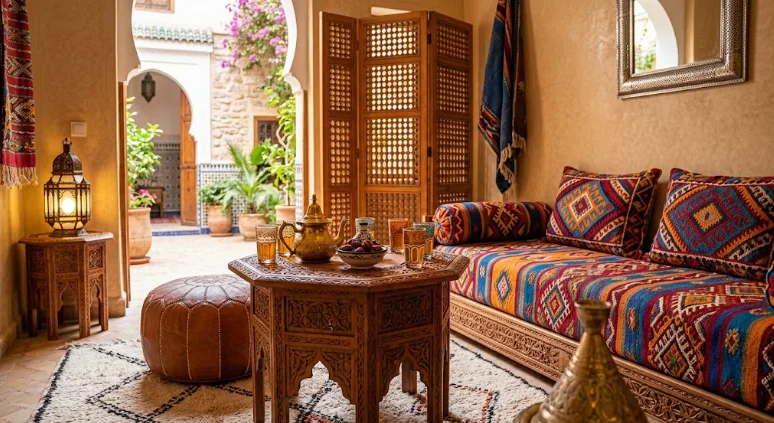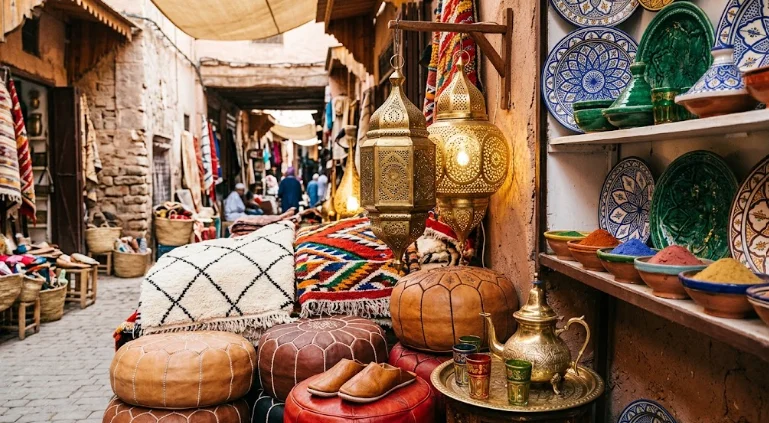


Moroccan Wooden Furniture: Secrets to the Ultimate Interior
- Home Décor & Traditional Crafts Moroccan Crafts
 Maroc Fans
- 0
- 23 minutes read

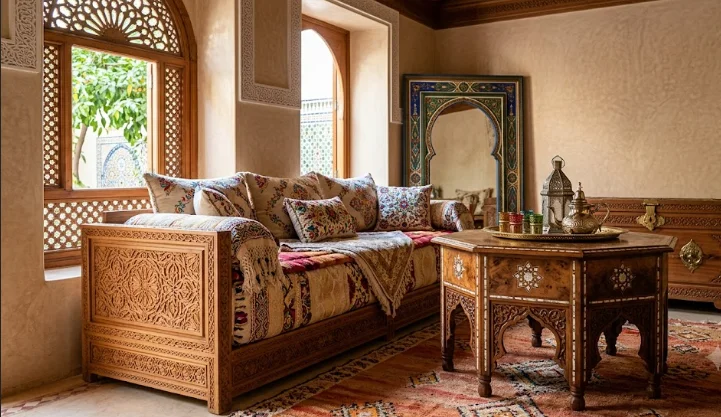
Stepping into a room adorned with authentic Moroccan wooden furniture feels like entering a living gallery of North African heritage. Every sculpted cedar sofa frame, delicately painted tea table, and hand-carved lattice screen tells a story that stretches back over centuries. Indeed, rooted in Amazigh (Berber) traditions, refined by Andalusian elegance, and shaped by Islamic geometric principles, Moroccan woodworking remains one of the world’s most evocative artisanal crafts.
Far beyond mere household utility, traditional Moroccan wooden furniture is designed to foster gathering, celebrate hospitality, and elevate daily life with tactile beauty. Whether you are looking to furnish a complete salon or introduce a single statement piece into a contemporary space, understanding the rich woods, historic techniques, and regional styles of Moroccan carpentry will help you appreciate the artistry behind every grain.
The Sacred Timber Behind Moroccan Wooden Furniture: Cedar and Thuya
The signature character of Moroccan wooden furniture relies heavily on the unique timber species native to the kingdom’s mountain ranges and coastal forests. Two trees in particular define this heritage: Atlas Cedar and Barbary Thuya.
Atlas Cedar (Cedrus atlantica)
Harvested primarily from the snow-capped Middle Atlas mountains near Azrou and Ifrane, Atlas cedar is the classic timber of Moroccan architecture and carpentry. Renowned for its warm amber hue, tight grain, and natural oils that resist humidity and insects, cedar has been used for centuries to construct grand palace doors, ceilings, and durable living room frames (seddari). Beyond its structural strength, Atlas cedar is famous for its intoxicating, balsam-like scent. Consequently, an authentic piece of cedar furniture infuses a room with an earthy fragrance that can last for decades, serving as a subtle natural aromatherapy.
Barbary Thuya Wood (Tetraclinis articulacy)
If cedar is the backbone of Moroccan woodworking, Thuya is its precious jewel. Native almost exclusively to the coastal hills around the Atlantic port of Essaouira, the Thuya tree produces dense, highly aromatic timber. While artisans value the straight trunk wood, they especially treasure the subterranean burl—the knotty root formation that grows beneath the earth. Thuya burl features mesmerizing, tight swirling grains and dark speckles known as “eyes.” Moreover, because it is heavy and naturally oil-rich, it takes a high-gloss polish exceptionally well, making it the timber of choice for high-end accent tables, decorative boxes, and intricate marquetry panels in Moroccan wooden furniture.
Interested in exploring more Moroccan craft traditions? Read our comprehensive guide on The Vibrant History of Moroccan Zellige Tilework to see how geometric woodwork pairs with ceramic art.
Core Techniques Used in Moroccan Wooden Furniture Craftsmanship
The transformation of raw timber into refined Moroccan wooden furniture requires years of rigorous apprenticeship. Master woodworkers (maalems) specialize in specific traditional techniques passed down through generations.
       ┌─────────────────────────────────────────────────────────┐
       │             Moroccan Woodworking Techniques             │
       └────────────────────────────┬────────────────────────────┘
                                    │
    ┌─────────────────┬─────────────┴───────────┬─────────────────┐
    │                 │                         │                 │
┌───▼───┐         ┌───▼───┐                 ┌───▼───┐         ┌───▼───┐
│ Zouak │         │ Inlay │                 │Lattice│         │ Carv  │
│ Paint │         │ & Marq│                 │ (Mou) │         │ Deep  │
└───────┘         └───────┘                 └───────┘         └───────┘
1. Zouak: poly-chrome Painting on Moroccan Wooden Furniture
Zouak is the traditional technique of hand-painting wood with vivid geometric and floral patterns. Using fine natural hair brushes and organic pigments, the painter transforms simple wood panels into radiant canvases of cobalt blue, emerald green, deep red, and gleaming gold. Furthermore, the patterns follow strict geometric grids (tewriq for floral arabesque motifs and hasba for star polygons). You will commonly find zouak applied to dining tables, mirror frames, ceiling beams, and the wooden bases of traditional sofas.
2. Moucharabieh: Architectural Lattice Work in Furniture
Originally developed to provide privacy and ventilation in Islamic architecture, Moucharabieh (or Mashrabiya) is the art of assembling thousands of small, hand-turned wooden cylinders into intricate lattice screens. Without using a single metal nail, master carpenters join these tiny wooden pieces together using traditional tongue-and-groove joinery. As a result, Moucharabieh diffuses harsh sunlight into soft, dappled patterns across a room while allowing breezes to pass through. Today, this technique is widely used in freestanding room dividers, cabinet doors, and lantern shades.
3. Marquetry and Bone Inlay in Wooden Furniture
Popularized in the coastal town of Essaouira, marquetry is the art of creating intricate surface mosaics using contrasting materials. Artisans cut razor-thin slivers of dark Thuya burl, pale lemonwood, ebony, camel bone, and delicate silver wire. Subsequently, these pieces are meticulously fitted onto a wooden base to form geometric stars, scrolling vines, and mosaic borders. The resulting surface is sanded smooth and finished with natural beeswax, producing a silky, luminous texture.
4. Deep Sculpture and Relief Carving
For architectural elements and heavy Moroccan wooden furniture, woodcarvers use hand chisels (manqar) to cut deep relief patterns directly into solid cedar planks. From repeating star polygons to Arabic calligraphy, relief carving gives the pieces a dramatic three-dimensional texture that catches natural light and shadow throughout the day.
Iconic Types of Moroccan Wooden Furniture
When curating an authentic interior, several key furniture items define the aesthetic. Each piece serves both a practical and social purpose in the home.
| Furniture Piece | Primary Materials | Traditional Function |
| Seddari Frame | Atlas Cedar, Carved/Painted Wood | Low seating foundation for salons |
| Tabla (Tea Table) | Cedar, Thuya, Inlaid Bone/Pearl | Central coffee or tea serving table |
| Sondouq (Bridal Chest) | Cedar or Thuya with Brass Knobs | Secure storage for textiles & gifts |
| Moucharabieh Screen | Turned Cedar or Walnut | Privacy divider and ambient filter |
The Seddari (Moroccan Salon Sofa Frame)
The centerpiece of any traditional home is the Seddari. Unlike Western sofas with upholstered internal frames, a seddari consists of a long, solid Moroccan wooden furniture bench—often deeply carved or hand-painted with zouak motifs—topped with dense firm mattresses and an array of decorative cushions. Arranged around the perimeter of a reception room, the seddari is designed to accommodate large family gatherings comfortably for hours. In addition, the exposed wooden base and ornamental legs are where master woodworkers showcase their finest floral and geometric carvings.
The Tabla: Octagonal and Hexagonal Moroccan Wooden Tea Tables
No salon is complete without a low wooden tea table (tabla). Typically octagonal or hexagonal, these tables feature intricately carved legs and heavily decorated tops designed to hold the traditional brass tea tray, mint teapot, and tea glasses. Higher-end tables often combine cedar wood with bone or mother-of-pearl inlay, making them striking focal points even when not in use.
The Sondouq: Handcrafted Moroccan Wooden Storage Chests
Historically given to brides as part of their dowry, the Sondouq is a heavy wooden trunk crafted from solid cedar or Thuya wood. Featuring detailed hand-carved panels, hand-forged iron handles, and intricate latch mechanisms, these chests were designed to store fine textiles, jewelry, and family heirlooms. However, in modern interior design, a vintage sondouq serves beautifully as a rustic coffee table or blanket chest at the foot of a bed.
Hand-Carved Mirrors and Wooden Headboards
Moroccan wood artisans excel at framing mirrors with grand architectural archways inspired by the horseshoe arches of Moorish palaces. Thus, a carved cedar or painted zouak mirror creates a commanding focal point in an entryway or bathroom. Similarly, oversized wooden headboards featuring moucharabieh lattice or deep geometric carving bring regal warmth to modern bedrooms.
Planning a trip to source original pieces? Check out our insider guide on Navigating the Souks of Marrakech: A Shopper’s Handbook for tips on negotiating directly with local woodcarvers.
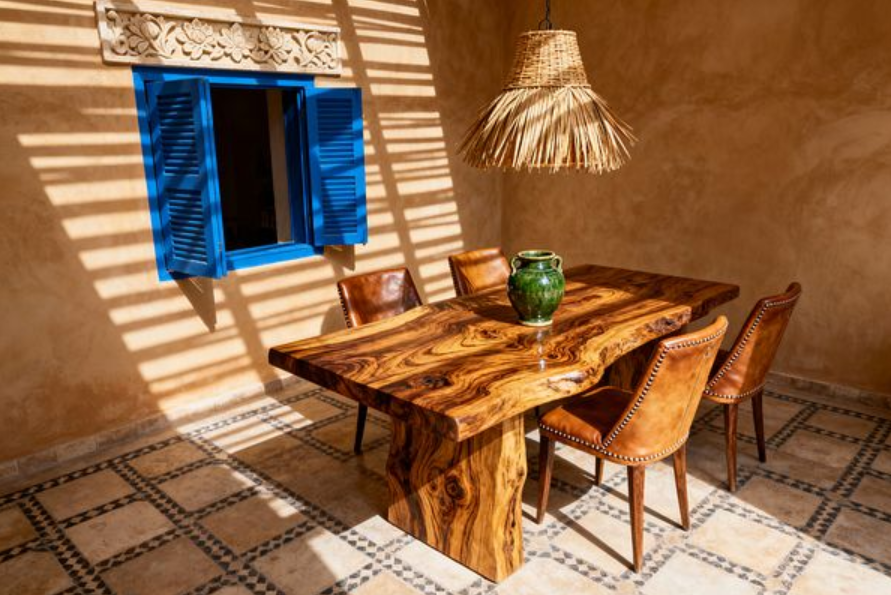
Regional Centers of Moroccan Wooden Furniture Craftsmanship
While woodworking flourishes across the country, three cities stand out as historical hubs, each possessing its own distinct style and specialization.
                ┌─────────────────────────────────────────┐
                │   Moroccan Woodworking Regional Hubs    │
                └────────────────────┬────────────────────┘
                                     │
         ┌───────────────────────────┼───────────────────────────┐
         │                           │                           │
  ┌──────▼──────┐             ┌──────▼──────┐             ┌──────▼──────┐
  │     FEZ     │             │   MEKNES    │             │ ESSAOUIRA   │
  │ Cedar Wood  │             │ Painted Wood│             │ Thuya Wood  │
  │ Architectural│            │ (Zouak)     │             │ Marquetry   │
  └─────────────┘             └─────────────┘             └─────────────┘
Fez: The Capital of Architectural Cedar Furniture
The ancient Medina of Fez (Fes el-Bali) is home to the Nejjarine quarter—the historic district dedicated entirely to carpenters. Fez woodworkers are world-renowned for structural cedar carving, architectural doors, and complex geometric ceiling frames. In fact, the famous Place Nejjarine, with its spectacular 18th-century fondouk (now the Museum of Wooden Arts and Crafts), stands as a lasting tribute to the city’s woodworking legacy.
Meknes: Master City of Painted Moroccan Wooden Furniture (Zouak)
Located close to the Middle Atlas cedar forests, Meknes developed a specialized reputation for polychrome painting. The royal workshops of Meknes historically supplied painted cedar ceilings, doors, and furniture for imperial palaces. Today, Meknes remains the primary hub for authentic zouak technique on Moroccan wooden furniture.
Essaouira: The Hub for Thuya Moroccan Wooden Furniture
Perched on the Atlantic coast, Essaouira is synonymous with Barbary Thuya wood. Under the historic ramparts (skala), the city’s artisans have perfected the technique of embedding lemonwood, mother-of-pearl, and camel bone into dark Thuya burl. Walking through Essaouira’s medina, you will find that the air is constantly filled with the rich, aromatic perfume of freshly sanded Thuya wood.
How to Style Moroccan Wooden Furniture in Modern Interiors
You don’t need a traditional riad to enjoy the beauty of Moroccan wooden furniture. The warm tones and geometric textures of Moroccan cedar and Thuya pieces blend remarkably well with contemporary Western aesthetics.
              ┌──────────────────────────────────────────────┐
              │  Styling Moroccan Wood in Modern Spaces     │
              └──────────────────────┬───────────────────────┘
                                     │
         ┌───────────────────────────┼───────────────────────────┐
         │                           │                           │
  ┌──────▼──────┐             ┌──────▼──────┐             ┌──────▼──────┐
  │ Bohemian    │             │ Contemporary│             │ Warm        │
  │ Layering    │             │ Focal Point │             │ Minimalist  │
  └─────────────┘             └─────────────┘             └─────────────┘
1. The Bohemian Chic Approach with Moroccan Wooden Furniture
For a warm, eclectic vibe, combine a hand-carved cedar seddari or coffee table with rich textiles. First, layer high-pile wool rugs under the table. Next, add leather poufs and drape woven throw blankets across seating. The rich wood grain grounds the varied textile patterns and adds an organic, relaxed atmosphere to the space.
2. Contemporary Spaces and Moroccan Wooden Furniture Statements
If your modern home features clean, minimalist lines and neutral color palettes, introduce a single high-impact piece. For instance, an intricate moucharabieh room divider can act as architectural art against a white wall. Alternatively, a polished Thuya burl console table provides warm texture without cluttering a minimalist hallway.
3. Warm Mediterranean Styling with Moroccan Wooden Furniture
Moroccan wooden furniture pairs naturally with natural lime-wash plaster walls, terracotta floor tiles, and abundant indoor greenery. Therefore, incorporating an octagonal painted tea table or carved wall mirrors creates a sun-drenched, Mediterranean oasis that feels grounded and connected to nature.
Complete your home transformation by exploring our styling guide on How to Choose an Authentic Berber Rug for Your Home.
How to Identify Authentic Moroccan Wooden Furniture
With the rise of mass production, machine-routed replicas made from low-grade plywood or pine have entered the market. Therefore, to ensure you are investing in genuine Moroccan wooden furniture, look for the following markers:
- Scent: Real Atlas cedar and Barbary Thuya wood possess strong, natural aromas. Conversely, synthetic or stained pine furniture lacks this distinctive natural fragrance.
- Grain Imperfections: Authentic Thuya burl features irregular, tight clusters of dark “eyes” and swirling grain patterns. Machine-printed or veneer imitations repeat identical patterns unnaturally.
- Hand-Chiseled Details: Look closely at the carvings. Microscopic variations in depth and chisel marks confirm that an artisan carved the piece by hand rather than using a computerized CNC router.
- Traditional Joinery: Traditional Moroccan carpenters rely on mortise-and-tenon or tongue-and-groove joints rather than modern plastic fasteners or visible metal brackets.
Care and Maintenance for Heirloom Moroccan Wooden Furniture
Proper care ensures that your handcrafted Moroccan wooden furniture retains its beauty, perfume, and structural integrity for generations.
- Avoid Direct Sunlight and Radiators: Extreme heat and dry air can cause solid wood to crack or warp. For this reason, keep your cedar and Thuya furniture away from direct heat sources and harsh midday sun exposure.
- Nourish with Natural Beeswax: Avoid harsh chemical sprays or silicone polishes. Every six to twelve months, apply a thin coat of natural beeswax or specialized wood oil using a soft cotton cloth to feed the wood fibers and enhance the grain.
- Dust with Microfiber: For intricate zouak painted wood or moucharabieh lattice, use a soft-bristled dry brush or microfiber cloth to clean deep crevices gently without scratching the surface varnish.
- Maintain Room Humidity: Moroccan woods thrive in moderate humidity levels (40% to 60%). Consequently, using a room humidifier during dry winter months will protect your wooden pieces from shrinking.
Handcrafted Moroccan wooden furniture represents a timeless synthesis of natural beauty, geometric precision, and human craftsmanship. From the aromatic cedar bench frames of Fez to the luminous Thuya marquetry of Essaouira, these pieces offer far more than aesthetic appeal—they bring warmth, history, and social connection into the heart of your living space. By choosing authentic artisan-crafted furniture and caring for it properly, you preserve an ancient art form while investing in functional heirlooms that will enrich your home for a lifetime.
Frequently Asked Questions (FAQ) About Moroccan Wooden Furniture
1. What wood is most commonly used in Moroccan wooden furniture?
The two most iconic woods used in Moroccan wooden furniture are Atlas Cedar (Cedrus atlantica), valued for structural furniture and architectural carving, and Barbary Thuya Wood (Tetraclinis articulacy), prized for its fragrant burl wood used in accent tables and inlaid decorative pieces.
2. What is the difference between Zouak and traditional wood carving?
Wood carving involves cutting three-dimensional relief patterns directly into solid wood using chisels. Conversely, Zouak is a technique where intricate geometric and floral patterns are hand-painted onto wood surfaces using mineral pigments and fine brushes. Many high-end Moroccan pieces combine both techniques.
3. What is a Moroccan Seddari in Moroccan wooden furniture?
A Seddari is a traditional sofa composed of a long, raised Moroccan wooden furniture base—often heavily carved or painted—fitted with a firm cushion mattress and decorative throw pillows. They are typically arranged around the perimeter of a living room to accommodate guests during social gatherings.
4. Why is Thuya Moroccan wooden furniture so expensive and highly valued?
Barbary Thuya wood grows almost exclusively in the coastal regions of Morocco. In addition, the most prized parts come from the subterranean burl (root system), which takes decades to form dense, swirling grain patterns. Because the tree is protected and harvest quotas are strictly regulated, authentic Thuya wood furniture is a rare and luxurious investment.
5. Can Moroccan wooden furniture be used outdoors?
While solid cedar possesses natural weather-resistant oils, traditional Moroccan wooden furniture with zouak paint or delicate wood/bone inlay should be kept indoors or on covered patios sheltered from rain and direct sunlight. Prolonged moisture exposure can damage hand-applied paints and loosen glued marquetry inlays.
6. How do I clear dust out of intricate Moucharabieh screens?
Use a vacuum cleaner equipped with a soft brush attachment on low suction, or use a soft paint brush to sweep dust out of the turned wood joints. Furthermore, avoid using wet cloths, as water can trap dust inside tight wooden crevices.
7. How can I tell if painted Moroccan wooden furniture is authentic?
Hand-painted zouak displays subtle variations in line thickness, brushstroke texture, and minor natural asymmetries. On the other hand, mass-produced printed imitations feature perfectly flat, uniform patterns without depth or visible paint layers.