



Artisanal Moroccan Zellige: Authentic Tilework Guide
- Moroccan Crafts Pottery & Zellige
 Maroc Fans
- 0
- 25 minutes read

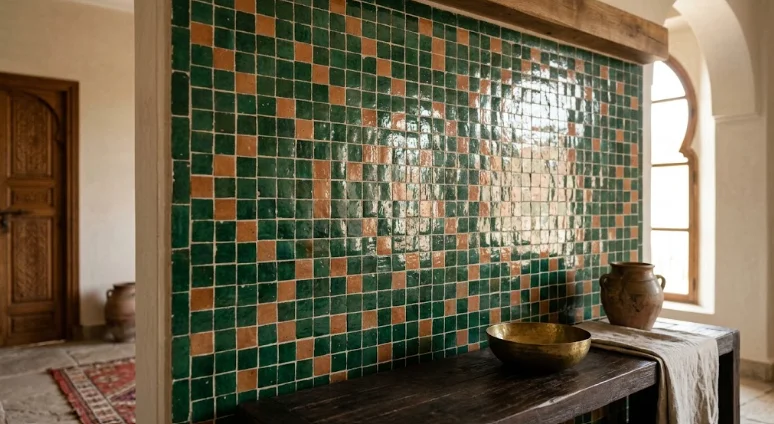
For centuries, Morocco’s architectural identity has been anchored in the vibrant, geometrically complex beauty of artisanal Moroccan Zellige. From the grand palaces of Marrakech and Fes to quiet courtyards and contemporary luxury homes around the globe, these hand-chiseled terracotta tiles represent one of the world’s most sophisticated craft traditions.
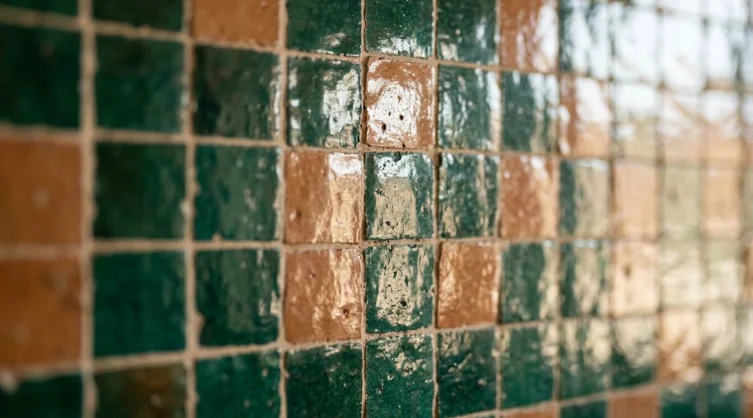
Unlike mass-produced ceramic tiles, authentic artisanal Moroccan Zellige is defined by human imperfection: subtle variations in glaze tone, slight organic ripples on the surface, and hand-cut edges that allow pieces to fit together with barely visible mortar joints.
In this comprehensive guide, we step inside the traditional ceramic workshops (zellijs) of Morocco to explore the step-by-step manufacturing process, the tools used by master craftsmen (Maâlems), and how to select, install, and care for authentic artisanal Moroccan Zellige tile.
What Is Authentic Artisanal Moroccan Zellige?
At its core, artisanal Moroccan Zellige is a style of mosaic tilework made from natural clay that is hand-shaped, sun-dried, kiln-fired, glazed, and meticulously chiseled into precise geometric shapes.
Originating in North Africa and Islamic Iberia (Al-Andalus) as early as the 10th century, Zellige evolved from simple monochromatic tile installations into breathtaking Islamic geometric patterns (Tawriq and Girih).
[Raw Grey Clay] ──> [Kiln Firing 1] ──> [Enameling/Glazing] ──> [Kiln Firing 2] ──> [Hand-Cutting] ──> [Mosaic Assembly]
Key Attributes of Genuine Artisanal Moroccan Zellige:
- Natural Grey Clay: Extracted primarily from the rich, mineral-heavy soil surrounding the imperial city of Fes.
- Hand-Applied Enamel: Glazes derived from natural metallic oxides and minerals.
- Chiseled Edges (Bejmat and Zellige): Beveled edges cut using a heavy hammer called a Manqach.
- Unique Variation: No two tiles are identical in color, thickness, or texture.
Step-by-Step: How Artisans Manufacture Artisanal Moroccan Zellige Tile
The production of artisanal Moroccan Zellige is an ancient art form that has remained largely unchanged for hundreds of years. It demands physical strength, absolute precision, and decades of passed-down knowledge.
+-----------------------------------------------------------------------------------+
|                    THE 6 STAGES OF ARTISANAL MOROCCAN ZELLIGE                     |
+-------------------+---------------------------------------------------------------+
| 1. Clay Extraction| Sourced locally, soaked in water pits, and kneaded by hand.   |
| 2. Hand Shaping   | Pressed into wooden molds (*Thaya*) and sun-dried outdoors.   |
| 3. First Firing   | Baked in traditional olive-pit or wood kilns (*Khourcha*).   |
| 4. Enameling      | Coated in liquid glass glaze mixed with metallic oxides.      |
| 5. Second Firing  | Kiln-fired where temperature variations create tone shifts.    |
| 6. Precision Cut  | Master artisans hand-chisel geometric pieces using a *Manqach*.|
+-------------------+---------------------------------------------------------------+
Step 1: Clay Harvesting and Preparation
The story of artisanal Moroccan Zellige begins in the earth. Clay is harvested from specific quarries, most notably around Fes, where the soil contains an ideal balance of lime and minerals that prevents cracking during firing.
- Soaking: Raw clay rocks are placed in large outdoor water basins (Zoubia) for several days until fully soft.
- Purifying: Artisans stomp through the wet clay to remove roots, stones, and air pockets.
- Kneading: The clay is worked repeatedly until it reaches a smooth, uniform texture similar to bread dough.
Step 2: Hand Shaping and Sun-Drying
Once prepared, the clay is flattened into flat squares on smooth ground or wooden worktables.
- Artisans use wooden molds called Thaya to shape uniform clay slabs, typically measuring about 10×10 cm or 15×15 cm with a thickness of 1.5 cm to 2 cm.
- The fresh tiles are laid out under the Moroccan sun to dry naturally. Drying time varies depending on the season, taking anywhere from three days in summer to two weeks in winter.
Step 3: First Firing (Bisque Firing)
Once completely dry, the raw clay tiles—now called Bisque or Fakhar—are stacked inside a traditional olive-pit or wood-fired kiln (Khourcha).
- The tiles are baked at temperatures reaching approximately 800∘C to 900∘C.
- This initial firing hardens the raw clay into durable terracotta while maintaining porosity to absorb the upcoming enamel glaze.
Step 4: Enameling and Color Blending
After cooling from the first firing, the glazed side of the tile is created. Artisans submerge the top face of each bisque tile into a liquid glass enamel mixture.
Traditionally, glazes used in artisanal Moroccan Zellige were created purely using natural mineral oxides:
- Blue: Cobalt oxide
- Green: Copper oxide
- Yellow: Antimony or iron oxide
- White: Tin oxide
- Brown/Red: Manganese or natural iron-rich earth
Step 5: Second Glaze Firing
The glazed tiles return to the kiln for a second firing, often lasting up to 24 hours at temperatures over 1000∘C.
Because traditional kilns use heat currents that fluctuate depending on where a tile is placed inside the chamber, heat distribution is uneven:
- Tiles closer to the fire receive higher heat, producing deeper, glossier tones.
- Tiles situated near the top receive lower heat, yielding softer, matte-like shades.
This natural variance is precisely what gives artisanal Moroccan Zellige its famous “Shading Effect” (Nuance), where no two tiles in a box share the exact same hue.
  [Kiln Top - Cooler Temp]    ---> Softer hues / Semi-matte finish
  [Kiln Center - Optimal]     ---> Rich, glossy tone distribution
  [Kiln Base - High Heat]     ---> Deep saturation / Slight surface glaze variations
Step 6: Cutting and Chiseling (Nqach)
This step is where ordinary tiles transform into art. The trimming process requires extreme hand-eye coordination and years of apprenticeship under a Maâlem (Master Artisan).
   Raw Glazed Tile (10x10cm)
           │
           ▼
 [1. Stenciling Form]  ---> Lines drawn using iron template & bamboo pen
           │
           ▼
 [2. Rough Trimming]   ---> Edges clipped down using shears (*Meqta'a*)
           │
           ▼
 [3. Beveled Chisel]   ---> Sharp downward strike with heavy hammer (*Manqach*)
           │
           ▼
   Finished Zellige    ---> $45^\circ$ backward bevel for seamless jointing
- Drawing Patterns: The artisan uses a template made of sheet metal and a reed pen dipped in ink to trace precise geometric shapes onto the glazed face of the tile.
- Rough Edge Trimming (Meqta’a): Excess tile edge is clipped away using heavy shears.
- Beveled Chiseled Cut (Manqach): Holding a sharp, double-headed iron hammer weighing nearly 2 kg (Manqach), the artisan strikes the edges of the tile at a precise 45∘ angle.
Why the 45∘ Bevel Matters: Chiseling away the back terracotta edge while keeping the glazed enamel surface crisp allows artisanal Moroccan Zellige pieces to be laid directly against each other with ultra-thin grout lines (less than 1 mm), creating the illusion of a continuous mosaic surface.
Artisanal Moroccan Zellige vs. Bejmat vs. Cement Tiles vs. Machine Ceramics
Understanding tile variations is essential for choosing the right material for your renovation project.
| Feature / Property | Artisanal Moroccan Zellige | Moroccan Bejmat Tile | Traditional Cement Tiles | Factory Machine Ceramic |
|---|---|---|---|---|
| Manufacturing Method | Hand-pressed, kiln-fired, hand-cut | Hand-pressed, kiln-fired, un-chiseled | Cold hydraulic pressed | Industrial automated pressing |
| Material Composition | Natural clay + mineral glaze | Natural clay (glazed or unglazed) | Mineral cement + color pigments | Synthetic clay / porcelain powder |
| Tile Edges | Beveled 45∘ hand-cut edges | Straight, rustic natural edges | Straight 90∘ pressed edges | Perfectly rectified uniform edges |
| Color Variation | High (Nuanced/Varied) | High (Rustic/Varied) | Moderate (Solid/Patterned) | None (Uniform batch print) |
| Ideal Application | Walls, backsplashes, low-traffic accents | Floors, patios, high-traffic surfaces | Indoor floors, entryways | Bathrooms, heavy commercial floors |
| Grout Joint Width | Extremely tight (<1 mm) | Standard (2−3 mm) | Fine (1−2 mm) | Standard (2−4 mm) |
Architectural Patterns and Geometric Language
Artisanal Moroccan Zellige is not laid out at random; it follows intricate Islamic geometric principles that have governed Islamic art for centuries. Master craftsmen construct complex mosaic compositions (Khataem) without computer software, relying entirely on memory and geometric grid ratios.
Common Zellige Shapes:
- Square (Square 10×10 cm or 5×5 cm): The quintessential classic grid formation.
- Star Polygon (Nfiss / Setta wa Aachrin): 8, 12, 16, or 24-pointed stars forming central focal points.
- Lozenge / Rhombus (M’aagel): Used to build diamond meshes and lattice borders.
- Feather / Fish Scale (Qandil): Scalloped tiles creating flowing, curved wall movements.
Installation Guidelines: How to Install Artisanal Moroccan Zellige
Installing genuine hand-cut artisanal Moroccan Zellige is significantly different from setting standard machine ceramic tiles. Due to variations in tile thickness (10 mm to 15 mm) and irregular backings, installers must adapt their technique.
  +-----------------------------------------------------------------------+
  |              CROSS-SECTION OF A CORRECT ZELLIGE WALL ASSEMBLY          |
  +-----------------------------------------------------------------------+
  |  [ Wall Substrate (Drywall/Cement Backer Board) ]                      |
  |  [ Waterproofing Membrane / Liquid Barrier ]                          |
  |  [ Thin-set Mortar Bed (Troweled with 6mm-10mm Notch) ]                |
  |  [ Zellige Terracotta Body ] <--- Varied tile thickness adjusted here |
  |  [ Beveled Joint ]          <--- Butted close together (<1mm gap)     |
  |  [ Non-Sanded Flexible Fine Grout Slurry ]                            |
  +-----------------------------------------------------------------------+
1. Dry Laying & Color Blending
Before applying mortar, open several boxes of artisanal Moroccan Zellige simultaneously and lay out at least 2 to 3 m2 of tile on the floor. Blend light and dark shades evenly across the layout to prevent harsh patches of single tones on your wall.
2. Surface Preparation and Adhesive
Ensure the wall substrate is completely flat, clean, and waterproofed (especially in shower enclosures). Use a high-grade, polymer-modified thin-set mortar.
3. Buttering the Backs
Because artisanal Moroccan Zellige tiles vary slightly in thickness, the installer must “back-butter” each individual tile with mortar to bring all front glazed faces perfectly flush with one another.
4. Minimal Joint Spacing
Do not use plastic tile spacers. Authentic Zellige should be placed edge-to-edge (butted closely together), leaving a microscopic gap of less than 1 mm.
5. Grouting with Non-Sanded Slurry
Use a flexible, non-sanded grout. Apply liquid grout slurry across the entire face using a rubber float, working it deep into the tight joints. Wipe away excess grout immediately with a damp sponge.
Caution: Never use sanded grout on glazed Zellige. The coarse sand grains will scratch the glass surface during cleanup.
Maintenance and Care for Long-Lasting Beauty
Glazed artisanal Moroccan Zellige is durable, resistant to heat, and easy to keep clean when properly maintained.
- Daily Cleaning: Wipe surfaces down using warm water and a neutral pH soap or gentle natural dish detergent.
- Avoid Acidic Cleaners: Do not clean Zellige with vinegar, bleach, muriatic acid, or abrasive scouring pads, as these can strip the glaze shine or damage porous grout lines over time.
- Sealing Requirements: While the glazed top surface of Zellige is non-porous and water-resistant, unglazed terracotta areas and grout lines benefit from a penetrating sealer every 2–3 years in wet zones like shower walls.
Frequently Asked Questions (FAQ)
What makes artisanal Moroccan Zellige different from standard ceramic tiles?
Standard ceramic tiles are machine-pressed in automated factories, resulting in completely identical pieces, flat surfaces, and sharp 90-degree edges. Artisanal Moroccan Zellige is made entirely by hand from natural clay, fired in traditional kilns, and chiseled using hand tools. This creates subtle variations in tone, surface texture, and shape.
Is artisanal Moroccan Zellige tile suitable for shower walls and wet areas?
Yes! The glazed surface of artisanal Moroccan Zellige is waterproof and highly resistant to moisture, making it a popular choice for shower walls, bathroom vanities, and kitchen backsplashes. However, correct installation using proper waterproofing membranes and non-sanded grout is essential.
Can artisanal Moroccan Zellige be used on floor surfaces?
Traditional wall Zellige is thin and hand-cut with beveled edges, making it too delicate for heavy foot traffic floors. For flooring, use Bejmat—a thicker, un-chiseled rectangular Moroccan terracotta tile designed specifically to handle heavy floor wear.
Why do Zellige tiles have small chips and color variations?
Chipping along the edges (called Ebréchures) and color shading (Nuance) are intended characteristics of authentic hand-cut Zellige, not defects. They occur naturally during the manual hammer-chiseling process and kiln firing, giving the finished tilework its organic look.
How do I calculate how much artisanal Moroccan Zellige to order for my project?
Due to the handmade nature of Zellige and the necessity of trimming tiles during installation, it is recommended to order an extra 15% to 20% waste factor above your total square footage measurement.
Conclusion
The enduring appeal of artisanal Moroccan Zellige lies in its celebration of human craft over industrial perfection. Every chiseled edge, subtle shade shift, and light-reflecting ripple tells the story of Moroccan artisans keeping a centuries-old tradition alive. By understanding how Zellige is made, installed, and cared for, you can bring an authentic piece of architectural history into your contemporary living space.