

Traditional Moroccan Zellige: History, Craft & Uses
- Moroccan Crafts Pottery & Zellige
 Manal Hachi
- 0
- 23 minutes read

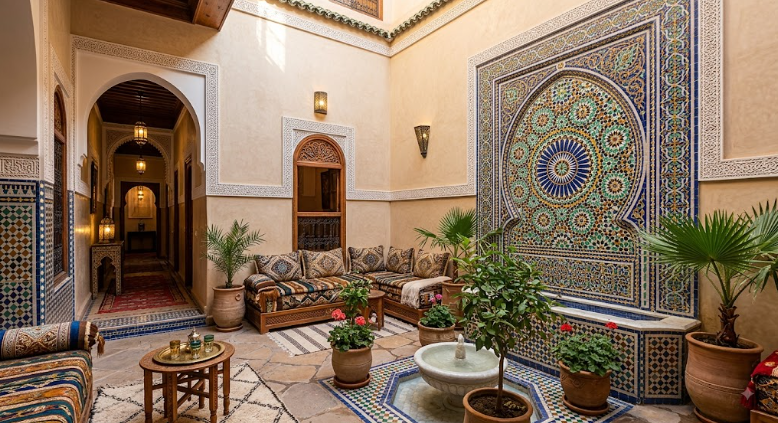
Traditional Moroccan Zellige stands as one of the most vibrant, complex, and enduring tile-making traditions in human history. Found adorning royal palaces, historic madrasas, tranquil riads, and sacred mosques, these hand-cut geometric ceramic tiles reflect a profound synthesis of Islamic architecture, Moorish geometry, and centuries of artisan dedication. Furthermore, as contemporary design trends increasingly embrace authentic craftsmanship, natural materials, and heritage aesthetics, traditional Moroccan zellige has successfully transcended its North African roots to become a sought-after architectural accent worldwide.
1. What is Traditional Moroccan Zellige?
Zellige refers specifically to the traditional art of glazed terracotta tilework hand-fashioned in Morocco. Unlike mass-produced ceramic or porcelain tiles manufactured via modern industrial presses, authentic traditional Moroccan zellige is completely handmade. Artisans utilize raw, locally sourced clay, traditional wood-fired kilns, and hand-chiseling techniques refined over a millennium.
       [ Local Clay Extraction ]
                   │
                   ▼
       [ Hand-Shaping & Sun Drying ]
                   │
                   ▼
       [ First Kiln Firing (Bisque) ]
                   │
                   ▼
       [ Hand-Glazing & Color Application ]
                   │
                   ▼
       [ Second Kiln Firing (Olive-Pit Fueled) ]
                   │
                   ▼
       [ Precise Chiseling (Tancheux Hammer) ]
                   │
                   ▼
       [ Upside-Down Mosaic Assembly ]
Distinguishing visual hallmarks of true traditional Moroccan zellige include subtle irregularities across every surface. Individual components feature slight variations in color tone, depth, edge definition, and glaze thickness. When craftspeople combine hundreds or thousands of these individual pieces (furmah) into an intricate geometric mosaic, light bounces off the varied angles. Consequently, this creates a shimmering, dynamic visual effect that machine-made imitations simply cannot replicate.
2. Historical Origins of Traditional Moroccan Zellige
The story begins in North Africa and Al-Andalus during the 10th century. Inspired by Byzantine and Roman mosaics, early Islamic craftspeople developed geometric glazed tilework as an expression of art consistent with Islamic religious traditions, because such traditions discouraged figurative representations in sacred spaces.
+————————————————————————-+
| ZELLIGE HISTORICAL TIMELINE |
+————————————————————————-+
| 10th Century: Early Monochromatic Forms |
| – Simple white and earth-toned glaze squares in early Maghrebi sites. |
| |
| 14th Century (Marinid Dynasty): The Golden Age |
| – Introduction of green, yellow, blue, and brown glazes. |
| – Construction of iconic monuments (Bou Inania Madrasa, Fez). |
| |
| 17th Century (Saadian Dynasty): Decorative Peak |
| – Intricate geometric starbursts and lace-like wall panels. |
| |
| 21st Century: Global Architectural Renaissance |
| – Modern interior design integration for kitchens, baths, and walls. |
+————————————————————————-+
The Marinid Golden Age
Reaching its historical apex during the Marinid Dynasty (13th–15th centuries) in Fez and Meknes, traditional Moroccan zellige was commissioned by sultans for elaborate madrasas, fountains, and royal palaces. During this era, the color palette expanded significantly from simple earth tones to include cobalt blues, rich emerald greens, and bright yellows.
Fez: The Intellectual and Artistic Capital
Fez became—and remains—the absolute heartland of traditional Moroccan zellige. Because the unique gray clay found in the hills surrounding Fez possesses an ideal mineral composition, it prevents cracking during firing and absorbs glazes evenly. Furthermore, historic madrasas such as the Bou Inania Madrasa and Al-Attarine Madrasa serve as timeless monuments to this artistic golden age.
3. Craftsmanship and Traditional Moroccan Zellige Production
The production of authentic traditional Moroccan zellige is an exacting, labor-intensive process requiring years of specialized training. Because master artisans oversee every phase of production, overall quality remains exceptionally high.
+————————————————————————-+
| THE 5 PHASES OF TRADITIONAL CREATION |
+————————————————————————-+
| 1. Clay Preparation -> Filtered, soaked, shaped by hand, sun-dried. |
| 2. Bisque Firing -> Kiln-fired using natural bio-mass fuels. |
| 3. Glazing -> Natural mineral glazes applied to raw surfaces.|
| 4. Chiseling -> Hand-shaped into geometric pieces (Furmah). |
| 5. Assembly -> Fitted upside-down without mortar gaps. |
+————————————————————————-+
Step 1: Clay Extraction and Preparation
Artisans harvest raw clay from local quarries around Fez, mixing it with water in large open pits before foot-trampling it to remove air bubbles. Afterward, workers flatten the clay into square slabs (roughly $10 \times 10\text{ cm}$) and leave them to dry naturally in the North African sun.
Step 2: The First Firing (Bisque)
Once fully dry, operators place the clay slabs into traditional brick kilns fueled by crushed olive pits from local presses. This first firing successfully transforms the raw material into durable terracotta.
Step 3: Glazing with Natural Minerals
Craftspeople hand-dip the dried terracotta slabs (kazi) into vibrant mineral glazes to achieve specific hues:
- Blue: Cobalt oxide
- Green: Copper oxide
- Yellow: Iron oxide or antimony
- Brown: Manganese
- White: Tin oxide
Step 4: Hand-Chiseling (Nqash)
Representing the most specialized stage of traditional Moroccan zellige production, makers sit before a small anvil block holding a heavy, double-headed steel hammer called a tancheux. Utilizing a stencil or memorized geometric grid, operators trace precise shapes onto the glazed tile. Swift, precise hammer strikes then cut out the shape while angling the back edge (champlevé cut). Thus, this angled back edge allows the face of the tiles to sit flush against one another during assembly without leaving visible grout lines.
Step 5: Assembly (Tarkib)
Teams assemble traditional Moroccan zellige panels upside-down on a flat floor inside a wooden frame:
- Master artisans place the cut pieces face down according to a complex geometric pattern entirely from memory.
- Once teams lay out the complete pattern face down, they pour a layer of cement mortar or modern resin substrate over the back.
- After setting, operators flip the panel over, revealing a perfectly seamless, perfectly aligned geometric mosaic ready for installation.
4. Geometric Sacred Art in Traditional Moroccan Zellige
Traditional Moroccan zellige is deeply intertwined with sacred geometry. In Islamic design, complex repeating patterns symbolize infinity, unity, and the boundless nature of creation.
                  _.-''''-._
                .'  \  |  /  '.
               /  \  \ | /  /  \
              |----\--(+--/----|
               \  /  / | \  \  /
                '.  /  |  \  .'
                  `-....-`
        [ Moroccan Star Polygon: Hasba ]
Key Pattern Elements
- Hasba (Star Polygons): Serving as the central anchor of most geometric panels, these range from simple 8-pointed stars to intricate 16-, 24-, or 32-pointed stars.
- Tawriq (Foliate Motifs): Curved, leaf-like lines that balance rigid geometric angles.
- Khatam (Solomon’s Seal): An eight-pointed star formed by two overlapping squares, symbolizing wisdom and balance.
5. Zellige vs. Mass-Performance Alternative Tiles
Evaluating authentic hand-cut traditional Moroccan zellige against modern alternatives like standard glazed ceramic tiles or encaustic cement tiles helps designers select the right material for architectural or interior projects.
| Characteristic | Traditional Moroccan Zellige | Standard Glazed Ceramic Tiles | Encaustic Cement Tiles |
| Manufacturing Method | 100% Hand-cut & hand-glazed | Industrial high-pressure machine | Hydraulic press (pigmented cement) |
| Surface Finish | Glossy, uneven, variable texture | Perfectly flat, uniform sheen | Matte, smooth, slightly porous |
| Edge Detail | Hand-beveled, tight joints (~1mm) | Straight/rectified, wide grout | Square edge, medium grout lines |
| Color Variation | High natural variation per batch | Minimal to none | Moderate tone variance |
| Durability | High (indoor/outdoor wall use) | High (floor/wall standard) | High (requires sealing against stains) |
| Aesthetic Character | Unique handmade luxury accent | Uniform, commercial finish | Vintage, artisanal matte look |
6. Modern Applications of Traditional Moroccan Zellige
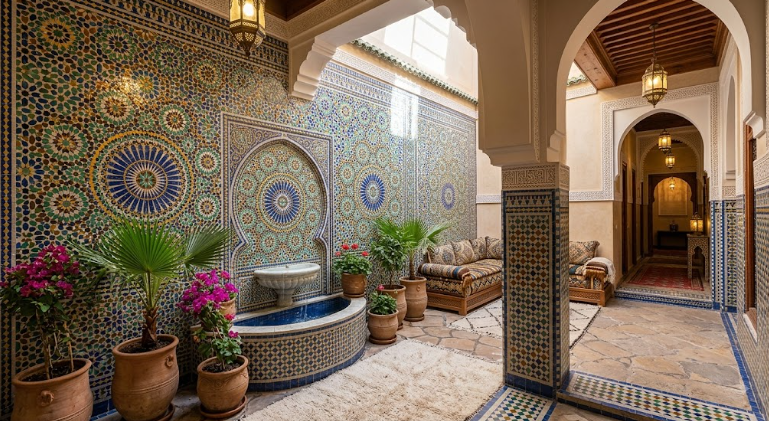
While historically reserved for royal palaces and sacred sites, traditional Moroccan zellige has found an enthusiastic home in contemporary interior architecture. High-end designers value its ability to introduce organic texture, light reflection, and artisanal warmth into minimalist or modern spaces.
+————————————————————————-+
| POPULAR MODERN ZELLIGE INTEGRATIONS |
+————————————————————————-+
| Kitchen Backsplashes -> Adds depth and shimmer behind cooktops. |
| Bathroom Shower Walls-> Reflects natural light; resists water moisture. |
| Fireplace Surrounds -> High thermal resistance; dramatic accent. |
| Outdoor Fountains -> Retains historical exterior architectural roots. |
+————————————————————————-+
Kitchen Backsplashes
Glazed traditional Moroccan zellige squares (such as $10 \times 10\text{ cm}$ or $5 \times 5\text{ cm}$ tiles) create a shimmering focal point behind kitchen countertops. Because the glossy finish reflects under-cabinet task lighting, it makes smaller kitchens feel bright and expansive.
Luxury Bathrooms and Wet Rooms
Since traditional Moroccan zellige glazes are water-impervious, installers frequently fit them in shower enclosures, vanity backsplashes, and accent walls. Furthermore, subtle variations in tone prevent large tiled surfaces from appearing monotonous or sterile.
Architectural Accents and Furniture
Beyond full walls, interior architects use traditional Moroccan zellige to highlight specific architectural features:
- Surrounding indoor fireplaces or archways.
- Cladding reception desks or kitchen islands.
- Decorating outdoor courtyard fountains, dining tables, and patio alcoves.
7. Installation Guide for Traditional Moroccan Zellige
Installing traditional Moroccan zellige requires specific techniques to accommodate its handmade nature and angled back edges.
       [ Wall Surface Preparation ]
                    │
                    ▼
       [ Dry Laying & Sorting Tile Tones ]
                    │
                    ▼
       [ High-Bond Flexible Adhesive Application ]
                    │
                    ▼
       [ Butt-Joint Tile Placement (~1mm Gap) ]
                    │
                    ▼
       [ Fluid Grouting & Surface Clean-Up ]
Installation Best Practices
- Dry-Laying First: Open multiple boxes and blend tiles across different batches to distribute natural color variations evenly across the wall.
- Substrate Preparation: Ensure the wall or floor substrate is flat, clean, and fully cured before installation.
- Adhesive Choice: Use a flexible, high-bond cementitious tile adhesive or polymer-modified mortar.
- Tight Jointing: Position tiles as close together as possible (typically $1\text{ to }2\text{ mm}$ gaps) to achieve the classic traditional Moroccan zellige look.
- Fluid Grouting: Apply a liquid grout over the surface, working it deep into the thin gaps between uneven edges. Consequently, clean tile faces immediately after grouting to prevent haze build-up.
Ongoing Maintenance
- Regular Cleaning: Clean glazed traditional Moroccan zellige surfaces using mild, pH-neutral soap and warm water. Avoid harsh acidic cleaners that can strip or damage grout lines.
- Sealing (If Unglazed): While glazed pieces require no surface sealing, unglazed traditional Moroccan zellige or raw grout lines should be treated with a penetrating sealer to prevent water staining.
8. Preserving Traditional Moroccan Zellige Heritage
In 2014, Morocco launched formal initiatives to protect and preserve traditional Moroccan zellige craftsmanship under national intellectual property frameworks and cultural heritage registries. Training centers in Fez and Marrakech now educate young apprentices in the mathematical precision and manual techniques required to maintain the art form.
By specifying authentic traditional Moroccan zellige, architects, designers, and homeowners help support local artisan cooperatives across Morocco, ensuring that this legendary Moorish craft thrives for future generations.
Frequently Asked Questions (FAQ)
What makes authentic traditional Moroccan zellige different from imitation ceramic tiles?
Authentic traditional Moroccan zellige panels are made from local clay, hand-fired in traditional kilns, and hand-chiseled using steel hammers. Imitation tiles are machine-pressed from uniform clay mixtures and printed with artificial surface textures. True hand-cut traditional Moroccan zellige features slight imperfections, color variances, and hand-beveled edges that machine production cannot duplicate.
Is traditional Moroccan zellige suitable for outdoor installation?
Yes. Glazed handles outdoor environments well, particularly in mild to hot climates. In regions prone to severe freeze-thaw winter conditions, traditional Moroccan zellige installed outdoors must be sealed correctly and protected against frost damage, or reserved for covered exterior walls.
Is traditional Moroccan zellige difficult to keep clean?
No. Glazed traditional Moroccan zellige pieces feature a smooth glass-like surface that resists stains, moisture, and mildew. Regular cleaning with warm water and mild dish soap is all that is required for everyday maintenance.
Why do traditional Moroccan zellige tiles have uneven edges and surface chips?
These minor imperfections are intentional hallmarks of the traditional craft. When the artisan chisels each piece with a heavy iron hammer (tancheux), minor chips along the glaze edge occur naturally. Therefore, these raw, hand-cut edges allow light to refract at varying angles once the mosaic is installed.